You’re #1 on Amazon.

See what all the screaming’s about.

You’re #1 on Amazon.
See what all the screaming’s about.

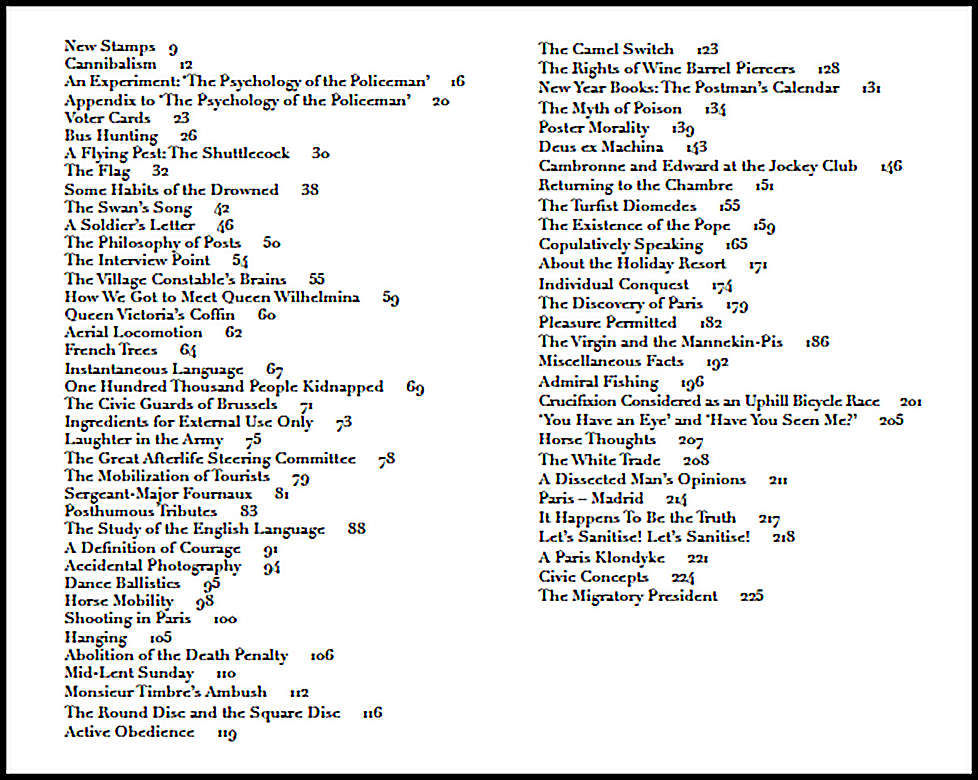
Alfred Jarry spent his brief and turbulent life experimenting with genres of fiction. In his last few years, he created a new fictional form: the absurdist speculative essay. R J Dent’s new English translation of Speculations contains 68 of Jarry’s essays, originally printed between 1901 and 1904 as a series, ‘Spéculations’, in the French journal Le Revue Blanche.
In Jarry’s darkly comic collection of surrealist and satirical prose pieces, the renowned author deploys his characteristic satirical eye and dark humor to devastating effect. These essays range in tone from the wildly comic to the deeply tragic and cover a diversity of subjects, ranging from French Trees to Cannibalism. For Jarry, nothing is sacred; everything is worthy material for his surreal satire; the Passion is presented as a sporting event; buses are the prey of big game hunters, and even the Queen is licked from behind.
A series of sly investigations into fin de siècle France that reads like a beautiful & bloody
handful of paper cuts, splintered essays that turn authority on its head in sharp bursts of
wicked logic, R J Dent elegantly capturing Jarry’s iconoclastic spirit, his scandalous heart.
—Matthew Kinlin
There’s a story that Jarry carried a loaded revolver around with him (said revolver Picasso obtained after his death, and took it with him on night walks around Paris). A woman living near Jarry complained to him about the danger of his gun-toting to her children. To which Jarry said, “If that should ever happen, ma-da-me, we should ourselves be happy to get new ones with you.” If you can appreciate as demented a sentiment as that, you can have a hundred more reading Speculations, in a delightful translation from R. J. Dent. —Conor Hultman, The Local Voice

Edible contents:
SPECULATIONS
Alfred Jarry
Translated by R J Dent
Paper; 5.06 x 7.81 inches; 235 pp., $15.95
ISBN 13 979-8-9859996-1-7
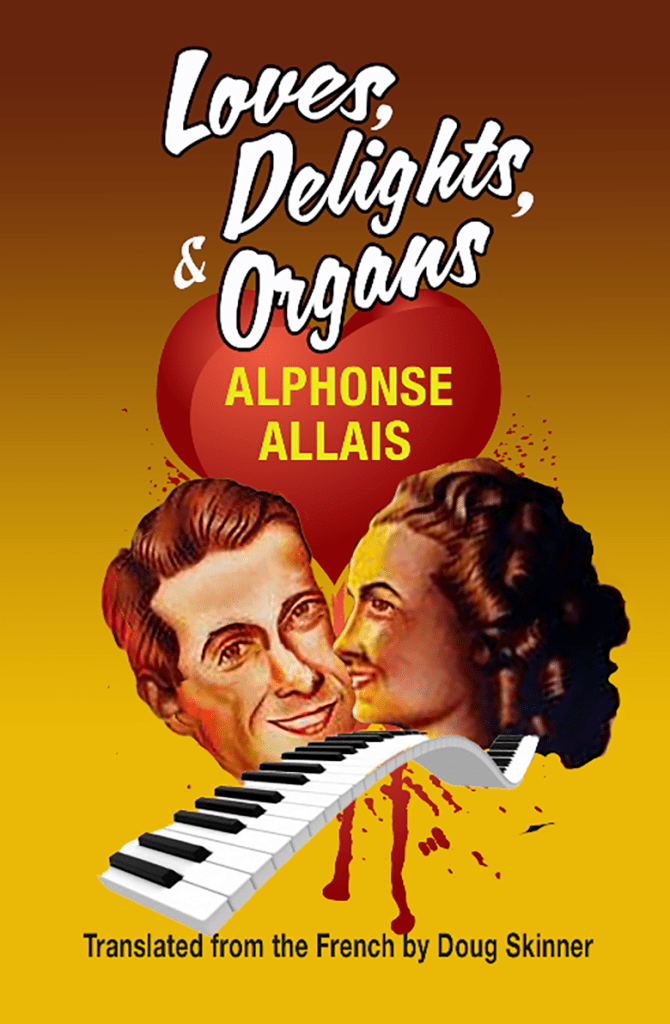
The master absurdist is back in LOVES, DELIGHTS, & ORGANS (Amours, délices et orgues). This madcap collection of stories, fables, hoaxes and jokes is pataphysical fun for the literate layabout. This first English translation features 47 sublime textual specimens — PLUS six additional stories, a rousing introduction, and enlightening notes on the translation by Allaisian scholar Doug Skinner. If you’ve yet to discover the bizarre world of Alphonse Allais, you’re in for a treat.
“Allais comes across as a very modern writer, and his work as an experimental enterprise which is exemplary in many ways… it is also quite possible to invoke such writers as Raymond Queneau, Italo Calvino, and Jorge Luis Borges.” —Jean-Marie Defays
ABOUT THE AUTHOR
Alphonse Allais was born in the Northern port town of Honfleur, in Calvados, on October 20, 1854. He was, therefore, born in the same town as Erik Satie, and on the same day as Arthur Rimbaud. His father was a pharmacist, and sent young Alphonse to Paris to learn the family trade. Young Alphonse mostly cut his classes, and steeped himself in the absinthe-soaked delights of bohemian Montmartre.
He joined the hard-drinking literary coterie the Hydropathes, accompanied the celebrated prankster Sapeck (Eugène Bataille) on his misadventures, submitted monochromatic pictures to the proto-Dada exhibitions of the Incohérents, and wrote squibs for various ephemeral papers. He became adept, in both word and deed, at the unique Parisian discipline of fumisme: a heady mix of hoaxing, provocation, and iconoclasm, all delivered with deadpan aplomb. Although he’d abandoned chemistry, his scientific credentials gave him a perspective (and persona) that set him apart from the more febrile poets around him. He was often likened to an English schoolmaster, with a placid demeanor that made his wild ideas all the more startling. [from the introduction by Doug Skinner]
 blackscatbooks.com