Book Worship

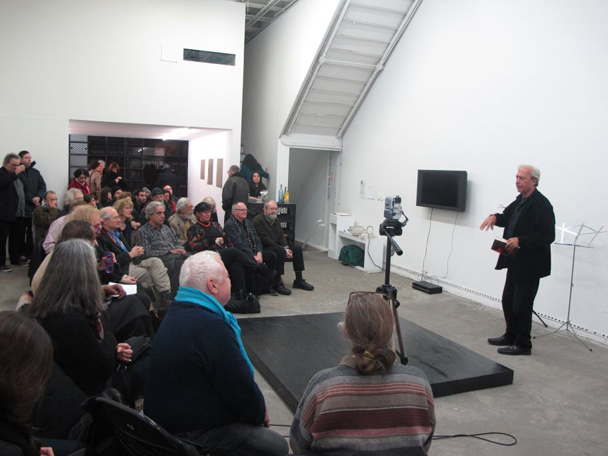
rkOn Monday 25 March, 7 pm. at McNally-Jackson, 52 Prince Street, between Lafayette and Mulberry Streets, Richard Kostelanetz will present over one dozen recent books rarely, if ever, seen before, most of them extending his earlier achievements at the intersection of literature and book-art, many of them produced with the seductive new technology of “on-demand printing” and thus reasonably priced, at least for now.

Among them are Epiphanies, two vols., 1000 pages, one story to a book page, culminating thirty years of work with resonant single-sentence climax moments in otherwise nonexistent fictions, a typographical feast for a monumental project, 8½” x 11”.

Conceptual Fictions, an extended essay with examples about the framing of implicit narratives.

Visual Fictions, collecting pages designed more than a decade ago for hisOpenings and Complete Stories, along with his Leonardo and Me.

Verbal Fictions, various formally alternative narratives that are not visually enhanced.

Vocal Shorts, an expanded edition of his texts designed for live performance for various numbers of players.

Openings Short Fictions, in the tradition of Epiphanies, the initial sentences of otherwise nonexistent stories.

Reflections on Loving and Relationships, his aphorisms continuously on right-hand pages against drawings of men and women made by the prominent choreographer Frances Alenikoff.

Furtherest Fictions, which reprints, revised, an earlier collection of his exploration of radically alternative narrative well beyond what every other fictioner is doing.

A Universe of Sentences, a continuous selection of lines by others worth remembering, the whole representing a universe of experience.

1001 Stories Enumerated, single-sentence fictions that, unlike Openings andEpiphanies, are meant to be complete in themselves.

Erotic Minimal Fictions, a variety of prose alternatives constituting the apex of avant-garde erotica.

Fields/Arenas/Pitches/Turfs, which completes the publication of geometric poems—with four, eight, and sixteen words to a large book page–begun thirty years ago.

1-99: A Book, another Kostelanetz narrative, in the tradition of Exhaustive Parallel Intervals (1979), composed only of numerals.

Ghostories, which are fictions created by boldfacing certain letters within a single word (e.g., address).

Homophones: Stories, where narratives are composed from two or sometimes more words that sound alike if spelled differently.

To & Fro &, where the reader’s discovery of narratives depend upon turning the book’s pages.

Ops & Clos, where opening and closings words, each pair with its own typography, are interspersed amidst each other.

English, Really English, in which he collects English words that seem incredible—over five thousand of them alphabetically in several perfectbound volumes.

What I Didn’t Do, which epitomizes intellectual nonhistory as Kostelanetz’s record of proposals that were never supported.

A Book of Eyes, photocopied and velobound, which explores the richly various ways that the single letter between H and J appears in contemporary typography

His presentation may also include such slightly older books as Skeptical Essays (Autonomedia), his latest collection of mostly severe criticism; Three Poems (NY Quarterly), where his experiments with three strains of one-word poetry appear interspersed; Micro Fictions (Archae), a limited-edition hardback with 900 pages of Louis Bury’s imaginatively designed narratives all three words and less; the reprint of his classic anthology of alternative expositions, Essaying Essays (AC Books); and maybe some others.

In May, Black Scat will publish Richard’s new book The Works & Life of Kosty Richards: An American Career in our Absurdist Texts & Documents series (#15)—thus adding to this vast library of experimental fiction.

Look it up!

lexicon-cover

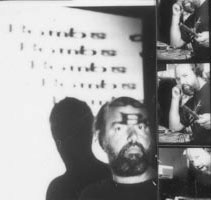
Masonic
Sound or sounds which pass rapidly through brick and stone walls

Matinee
A church service of morning prayer followed by a Biblical movie

Mausoleum
Hard floor-covering made of ground cork and linseed oil on a canvas backing, found in many large, imposing tombs throughout Asia Minor

Maximum
A full-time working mother with a large family

Mayonnaise
The sophisticated dance routine of a Central American Indian tribe who had formulated a highly developed civilization

Mazurka
A lively dance through a confusing, intricate network of pathways bordered with neatly kept topiary

Mediocre
The 15th Century sport of pissing in another’s glass of mead

Megger
A female mugger

Melancholia
A tonic made from cantaloupes prescribed to relieve extreme depression

Membranophone
A telephonic apparatus for transmission of sound or speech to a distant point through a pliable series of layers composed of animal or vegetable tissue (a soft house-phone)

Mercantile
A lizard-like reptilian found in many polluted waters

Mermaid’s purse
(Slang) A rather wet, slobbery kiss

Mesopause
The split floor area of a low story between two other stories of greater height in a building

Mesopeak
A mountain summit of lesser altitude than those which overshadow it on one or more sides

Metallurgy
A hypersensitivity to specific alloys such as brass or bronze

Metaphor
An imaginary apparatus for conveying objects and concepts which do not literally denote, in order to suggest comparison with another object or concept by means of mental signals, as a bright idea, the radiance of which may be changed

Methanation
An aggregation of Methodist persons of the same ethnic family, often speaking the same language or cognate languages

___
from The Complete Unabridged Lexicon by Opal Louis Nations

The Brighton Daily Herald says “Nations gives new meaning to the word definition.”

OUT OF PRINT

Live from New York…

scataround

nyc1

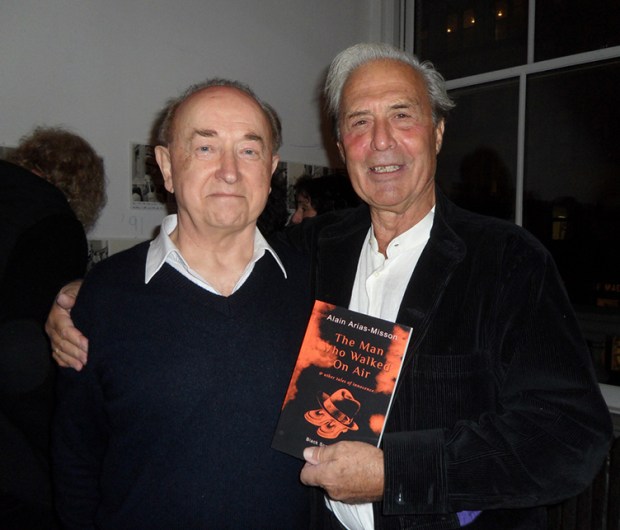
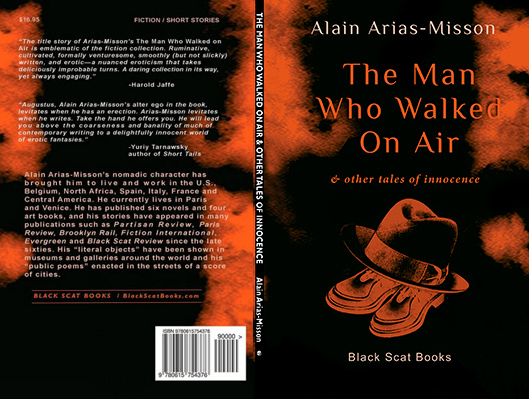
Literary legends Yuriy Tarnawsky (left) and Alain Arias-Misson at the Emily Harris Gallery reception last night. It was a glittering & festive evening marking Alain’s return visit to the Big Apple for a series of readings & performances (see previous post here). He holds in his hand a spanking new copy of his fiction collection, THE MAN WHO WALKED ON AIR & OTHER TALES OF INNOCENCE, published by Black Scat Books.

<<UPDATE—MARCH 16>>

uk-reading

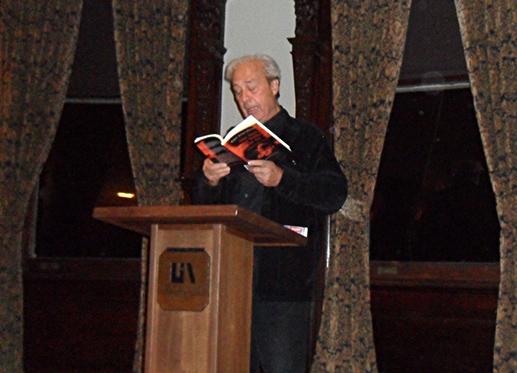
Alain Arias-Misson reading from his new collection of erotic “tales of innocence” to a packed crowd at the Ukrainian Institute of America. Everyone’s talking about The Man Who Walked On Air.  You can catch Alain tonight at the White Box for an “Avant-Garde Variety Show”‏—don’t miss It.   329 Broome Street, New York, NY 10002 | Tel: 212-714-2347.

Southern Discomfort…

cover12a

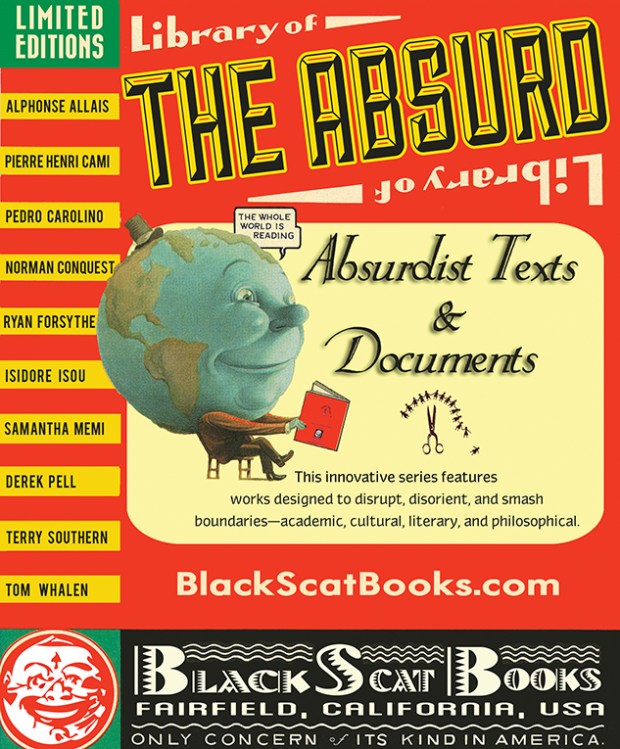
A yummy treat (for those with strong stomachs) is coming soon in our Absurdist Texts & Documents series…a new collection of strange  “tastes” from the late master chef Terry Southern:

HOT HEART OF BOAR & Other Tastes

We’ll be serving it fresh—piping hot and throbbing—in a limited edition of only 125 copies. First come, first served.

The book features rare unpublished texts, including an excerpt from The Hunters of Karinhall—a screenplay that, sadly, was never filmed. It’s a bloody masterpiece, and we do mean bloody. There’s also a private letter to William Burroughs; a vomiting priest; “K.Y. Madness,” and more.

In addition to the author’s culinary delights, you’ll find illuminating introductory notes by Nile Southern, as well as tastefully explicit illustrations by Norman Conquest.

In short, it’s a full-boar feast for famished fans of black humor.

Prepare to dig in.

Name your pleasure…

Here’s ours… The Pleasure Issue of Black Scat Review. It’s available here.

bsr2

Alain Arias-Misson, Jonathan Baumbach, Guy R. Beining, Eleanor Bennett, Miggs Burroughs, Pierre Henri Cami, John Crombie, Farewell Debut, Jacinta Escudos,
Stephen D. Gutierrez, Harold Jaffe, Richard Kostelanetz, Terri Lloyd, Samantha Memi, Opal Louis Nations, Derek Pell, Doug Skinner, D. Harlan Wilson

5¼” x 8¼”, Perfect-Bound. Full color. 78 pp.
$15  (PRINT EDITION)  /  $5  (DIGITAL EDITION)  CLICK HERE TO ORDER

Tzara in London

tzara1

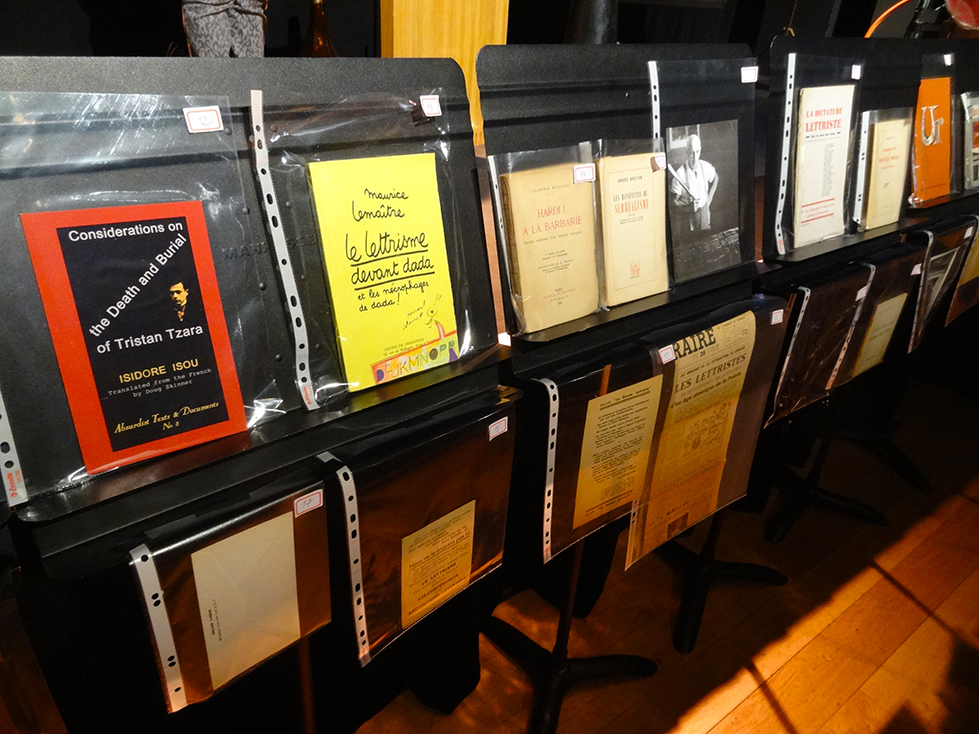
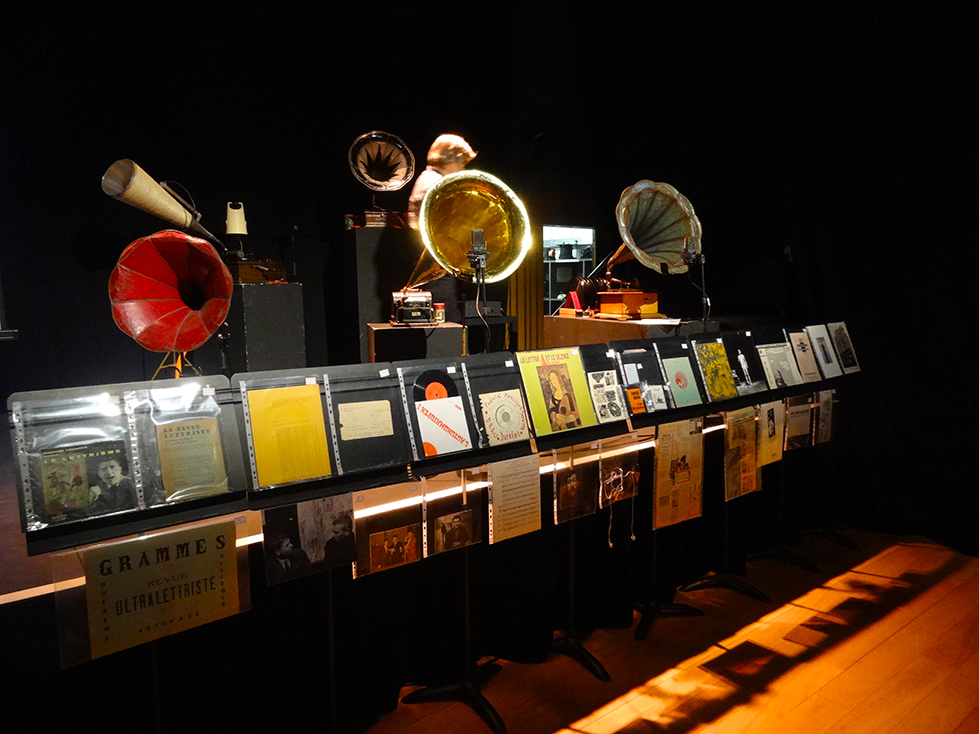
Considerations on the Death and Burial of Tristan Tzara by Isidore Isou,  (translated by Doug Skinner) was on display recently in London at an exhibition of DADA, LETTRISM, FLUXUS, FUTURISM, SOUND & CONCRETE POETRY, curated by Frédéric Acquaviva. Alas, we were not there for the festivities, but hear that the book was quite popular with attendees.

There are only a few copies remaining in Scat’s limited edition, so if you haven’t nabbed one  … now’s the time. CLICK HERE

tzara2photos courtesy of Frédéric Acquaviva

The Public Poem

EDITOR’S NOTE: THE WEEK OF  MARCH 11TH IN NEW YORK, THE CITY OF HIS CHILDHOOD, ALAIN ARIAS-MISSON WILL BE PRESENTING SEVERAL EXCITING EVENTS: THE FIRST IS A SHOW AT EMILY HARVEY FOUNDATION WHERE HE USED TO SHOW HIS WORK IN THE LATE ’70’S EARLY EARLY ’80’S. THERE WILL ALSO BE AN EVENT AT WHITE BOX (SEE PREVIOUS POST HERE.) MORE NEWS TO FOLLOW. IF YOU’RE IN THE AREA OR PLANNING TO VISIT, ALAIN WILL BE THERE TO GREET YOU WITH A SMILE.

THE PUBLIC POEM by ALAIN ARIAS-MISSON

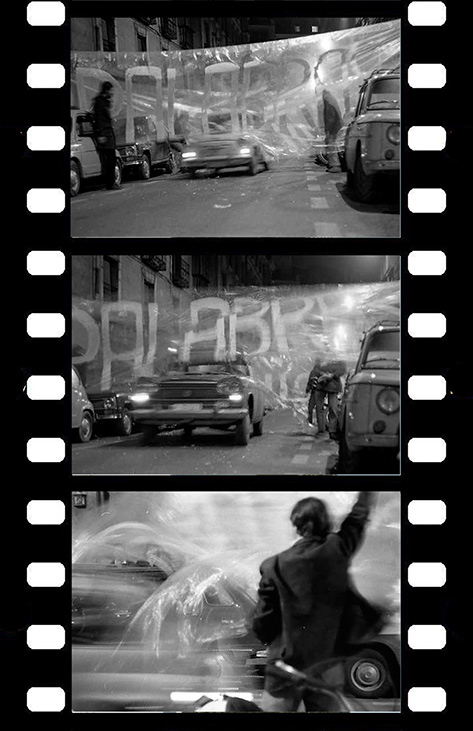
Alain Arias-Misson, born in Brussels, educated mostly in the U.S., describes himself as “a real fake-American, a fake real-Belgian”—a dual identity which extended into his life’s work: American novelist by vocation with seven books of experimental fiction, and European artist by accident-as one of the initiators of the visual poetry movement in the early sixties in Spain, Belgium, France and Italy. His works are represented in museums and galleries throughout Europe and the United States. His invention of the Public Poem in 1966-67, however, was a singular poetic experience: he decided he could “write on the street like a page”. His Public Poems or street-texts have since disrupted city life in a score of cities in Europe and the U.S.. 

The exhibition consists of a graphic-documentary illustration of his Public Poems and a video of seven Public Poems—on the occasion of the publication in the current issue of Performance Arts Journal of his Public Poems as the Artist’s Drawings section. Arias-Misson has deliberately enacted his Public Poems outside the “performances” circuit, in order to avoid an elitist art context: always taking place in the city streets, focal point of signs and polis, political-cultural milieu, the Public Poem uses minimal linguistic elements (such as grammatical symbols, let­ters, cartoon balloons) and iconic signs (masks, figures, materials) to point to or to frame an underlying city-text—in the symbolic and the functional aspects of traffic, police, monuments, public buildings, business, political and art institutions etc.. The public he addresses in the first place is the public in the street. Having begun this “street-poetry” in the Sixties, an era of cultural and urban effervescence, he feels that today with “Occupy Wall Street” and mass street demonstrations, his work again enjoys an aesthetic-social dynamic.

1

Madrid 1971                                                         Berlin 1991

THE PUBLIC POEM

(40 years of a street poetics)

 a one evening presentation/screening of documents & videos

Emily Harvey Foundation
537 Broadway
Thursday March 14th, 6 – 9 PM

****

AND MORE… what a lineup! Don’t miss this on March 15th!

Literary Evening 1

Start celebrating early — read THE MAN WHO WALKED ON AIR & OTHER TALES OF INNOCENCE

aircover