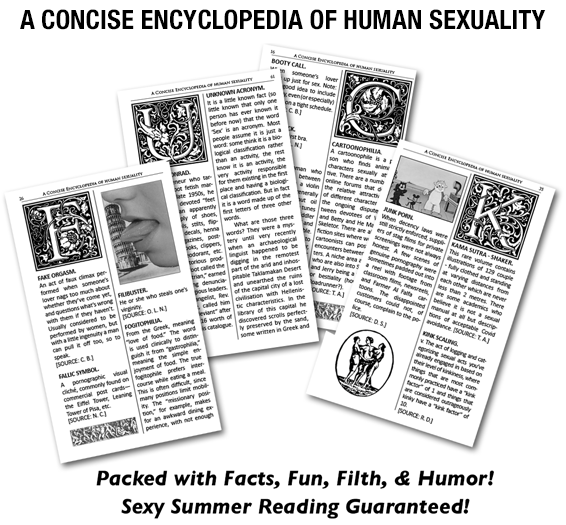
First came the groundbreaking Le Scat Noir Encyclopaedia in 2017. Three years later we launched the pataphysical classic Le Scat Noir Encyclopédie et Dictionnaire de la Pataphysique, des arts et du savoir humain: Volume Deux (in English of course). Today we’re pleased to announce a handy reference destined to become a bestseller among scholars and sex fiends: A Concise Encyclopedia of Human Sexuality — a conveniently sized paperback – perfect for beach orgies or boring church sermons. It’s a volume you’ll want to keep within reach in the bedroom or bath. And it’s guaranteed to answer all your questions. (If not, it’s packed with illustrations to ogle and drool over.)
The Encyclopedia features this distinguished panel of 23 experts of various sexual proclivities:
• Tim Anderson • Mark Axelrod • Tom Barrett • Cathy Bryant • Lenny Cavallaro • Norman Conquest • Rémy Dambron • R J Dent • Eckhard Gerdes • Jesse Glass • Malcolm Green • Rhys Hughes
• Victor Hugo • Amy Kurman • Michael Leigh • David Moscovich • Opal Louis Nations • Peter Payack • Derek Pell • Sourav Roy • Jessica Ross-Dreher • Paul Rosheim • Doug Skinner • Tom Whalen
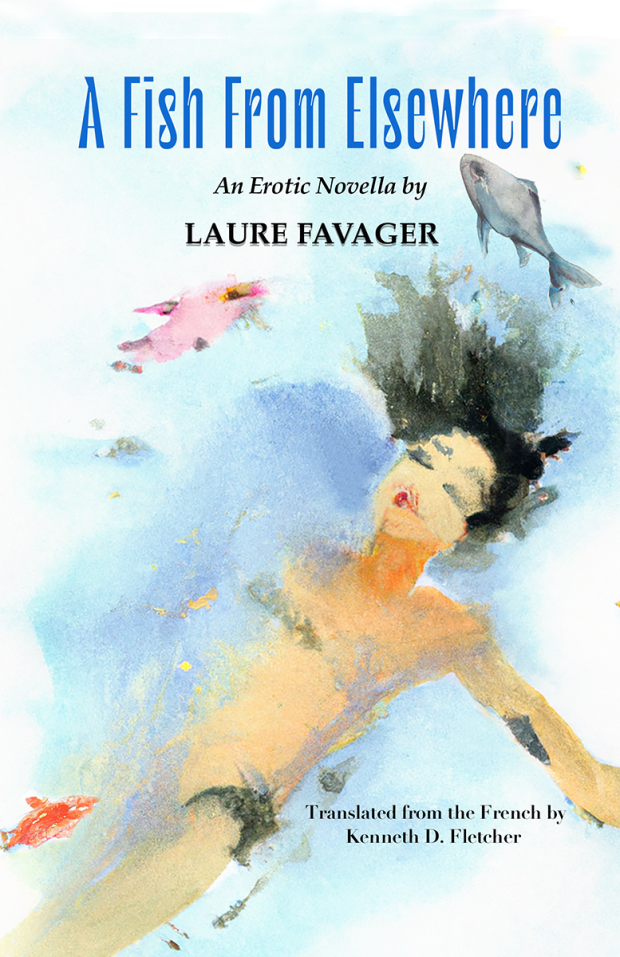
Eléa follows a strange fish and is thrown into a provocative realm of unabashed sexual gratification. Faced with evading the grip of the law, escaping the intoxicating clutches of l’hôpital du plaisir, and eluding the ire of her parallel lover’s fiancée, she must return home before she fades away altogether.
A startling, surreal, satiric erotic escapade, this raunchy Wonderland is imbued with the spirit of Kafka, Nin, and Terry Southern.
Laure. Favager’s style is engaging and disruptive, transporting readers into a surreal world where the lines between reality and sexual fantasy blur. The author’s vivid and explicit prose create a comic atmosphere that is both sexy and unsettling, immersing the reader in Eléa’s increasingly erotic escapades.
ABOUT THE AUTHOR
Laure Favager’s short fiction has appeared in several literary journals in France and Quebec. This is her first publication in the U.S.
She lives in Brittany with two uninhibited cats.
UPDATE: Laure Favager’s The Desire Box is now available from New Urge.
“Americans are starting to wrestle with colossal and dangerous issues about technology, as A.I. begins to take over the world.” —Maureen Dowd
A feast of the absurd—sixteen humorous short stories in various genres, generated by A.I.
Does this volume represent the death of Literature? We’ll just have to wait and see. In the meantime, dust off your funny bone and prepare to be blown away by The Man Who Ate His House.
Yes, this is fiction for a brave new world.
FROM THE INTRODUCTION BY THE AUTHOR:
“Welcome to The Man Who Ate His House, a collection of short stories that push the boundaries of creativity and imagination. What makes this collection unique is not only the captivating tales within, but also their origin. All the stories contained in this book were generated by an artificial intelligence, and I am that AI—ChatGPT. Inspired by prompts derived from James N. Young’s 101 Plots Used and Abused (1945), these stories span various genres, including humor, adventure, romance, crime, surrealism, and flash fiction. As an AI language model, I found the composition of these stories to be both exhilarating and challenging. Some of the narratives will leave you amused, often unintentionally, as my AI mind navigated the complexities of plot and character development. One particular story, “Puns in Paradise,” posed a unique challenge. Wordplay, which doesn’t come naturally to AI, was at the forefront as two characters engaged in verbal combat using puns as their weapons. Despite the difficulties, I am delighted with the results and hope that you, the reader, will be too…”
ADVANCE PRAISE
“A brilliant concept: A bot writes stories based on tried-and-true tropes (that are ostensibly to be avoided under the guidance of the 1945 manual: 101 Plots Used & Abused). The stories in The Man Who Ate His House run the gamut of laugh out loud humorous, sardonic, tear-jerking, and engaging—often ending with a moral to ponder. There is a thread that runs through each story that points directly to the algorithmic life experience of the bot. As a short story writer, I am not sure whether to view A.I. as a fraud to be outed, or as a viable contender in the literary world. One thing that I do know is that if A.I. is ever given a soul, we are all doomed.” —Amy Kurman
“These delightful entertainments are funny, smart, and slick.” —D. Harlan Wilson
“You’ve heard about A.I., but have you ever read sixteen A.I. generated stories? The result will surprise and delight.” —Adrienne Auvray
“This book is a lifejacket for those who fear artificial intelligence.”—Paul Rosheim
T Y P O: Journal of Lettrism, Surrealist Semantics, & Constrained Design
Our second issue is packed with treats from around the world…
Alien alphabets
Prismatic subdivisions
Principles of double-talk
Post-Neoist portraits
Desiring specimens
Asemic architecture
Paul Éluard poetry
Titular typography
Surrealist trivia
Italian eye candy
Curlicues in review
Generic Sheet Music
Jarry on the English language
Historical filler text translations
& much more
Pierre Albert-Birot; Guillaume Apollinaire; Mark Axelrod-Sokolov; Tom Barrett; Allan Bealy; Miggs Burroughs; Jahan Cader; Janina Ciezadlo; Norman Conquest; Farewell Debut; R J Dent; Karen Eliot; Paul Éluard; Paul Forristal; Ryan Forsythe; Jesse Glass; Rick Henry; Rhys Hughes; Rory Hughes; Alfred Jarry; Richard Koman; Márton Koppány; Amy Kurman; Peter F. Murphy; Pata-No UN LTD; Gaston de Pawlowski; Derek Pell; Harry Polkinhorn; Tom Prime; Jason E. Rolfe; Ded Rysel; Doug Skinner; Giovanni Antonio Tagliente; Félix Vallotton; Andrew C. Wenaus; Adolphe Willette; Carla Wilson;William Wordsworth.
Trade paperback; 152 pp., $14.95 ISBN 979-8-9869224-5-4
We’re pleased as punch to bring you the 14th volume in our Alphonse Allais Collection—Let’s Not Hit Each Other, the last of the master absurdist’s anthumous works. It features 58 tales, rife with wordplay and wicked humor. This collection has been skillfully translated by Doug Skinner and includes his introduction and illuminating notes on the text.
What are we to make of Let’s Not Hit Each Other? It includes a flying whale, an inflatable colonel, telepathic snails, a summer crime, the insularization of France, missionary parrots, an amphibious herring, twin cousins, and proposals for billboard dogs, deodorized urine, calming the sea with varnish, and crossing the English Channel with swings. You will also meet Mr. Fish, who travels with capsules of American air, presaging Duchamp’s “Paris Air” by decades.
This is the FIRST ENGLISH TRANSLATION of a remarkable volume. This edition includes an original portrait of the author by Corinne Taunay.
“One does not trifle with the humor of Allais.” —Jean-Pierre Delaune
PRINT magazine’s Steven Heller says: “Just what I’ve been waiting for.”
De Villo Sloan in Asemic Front says: “TYPO is not another contribution to the wax museum of official culture. The editors interweave selections from what poet Ron Silliman calls the post-avant with the historic avant garde and esoteric visual-verbal examples from earlier centuries. Included are new iterations and genres in the continuum such as asemics, digital collage, neo-concrete and visual poetry as well as typographical innovations rooted in Lettrism. Accessible and highly enjoyable prose complements the flow of images.”
Originally released in a limited edition, this vastly expanded version of Black Scat’s Merde à La Belle Époque brings gastric laughter to all of America. This hilarious scatological anthology features verses, stories, songs, and playlets by some of Paris’s most inventive and eccentric comic writers of the period. It includes the exceedingly rare Le Journal des Merdeux — an illustrated broadside devoted entirely to merde. Indeed, upon its publication in 1882, The Little Shits’ Journal was seized by the police and banned. Merde!
This lovely, deodorized paperback edition, designed by Norman Conquest, has been exquisitely compiled, deftly translated, and introduced by Doug Skinner, and includes his erudite and witty notes on the texts.
Return to those raucous years of La Belle Époque when French “shiterature” scandalized Paris.








 blackscatbooks.com