Dinner is served!

boar-relase

Fresh from the oven comes HOT HEART OF BOAR—piping hot and throbbing—in a limited edition of 125 copies. The collection features rare, unpublished texts, including an excerpt from The Hunters of Karinhall—a bloody brilliant uproduced screenplay (emphasis on “bloody”). There’s also a private letter to William Burroughs; a vomiting priest; “K.Y. Madness,” and more. In addition to the author’s culinary delights, you’ll find illuminating introductory notes by Nile Southern, as well as tastefully explicit illustrations by Norman Conquest.

In short, it’s is a full-boar feast for famished fans of black humor.

CLICK HERE TO ORDER

Book Worship

rkOn Monday 25 March, 7 pm. at McNally-Jackson, 52 Prince Street, between Lafayette and Mulberry Streets, Richard Kostelanetz will present over one dozen recent books rarely, if ever, seen before, most of them extending his earlier achievements at the intersection of literature and book-art, many of them produced with the seductive new technology of “on-demand printing” and thus reasonably priced, at least for now.

Among them are Epiphanies, two vols., 1000 pages, one story to a book page, culminating thirty years of work with resonant single-sentence climax moments in otherwise nonexistent fictions, a typographical feast for a monumental project, 8½” x 11”.

Conceptual Fictions, an extended essay with examples about the framing of implicit narratives.

Visual Fictions, collecting pages designed more than a decade ago for hisOpenings and Complete Stories, along with his Leonardo and Me.

Verbal Fictions, various formally alternative narratives that are not visually enhanced.

Vocal Shorts, an expanded edition of his texts designed for live performance for various numbers of players.

Openings Short Fictions, in the tradition of Epiphanies, the initial sentences of otherwise nonexistent stories.

Reflections on Loving and Relationships, his aphorisms continuously on right-hand pages against drawings of men and women made by the prominent choreographer Frances Alenikoff.

Furtherest Fictions, which reprints, revised, an earlier collection of his exploration of radically alternative narrative well beyond what every other fictioner is doing.

A Universe of Sentences, a continuous selection of lines by others worth remembering, the whole representing a universe of experience.

1001 Stories Enumerated, single-sentence fictions that, unlike Openings andEpiphanies, are meant to be complete in themselves.

Erotic Minimal Fictions, a variety of prose alternatives constituting the apex of avant-garde erotica.

Fields/Arenas/Pitches/Turfs, which completes the publication of geometric poems—with four, eight, and sixteen words to a large book page–begun thirty years ago.

1-99: A Book, another Kostelanetz narrative, in the tradition of Exhaustive Parallel Intervals (1979), composed only of numerals.

Ghostories, which are fictions created by boldfacing certain letters within a single word (e.g., address).

Homophones: Stories, where narratives are composed from two or sometimes more words that sound alike if spelled differently.

To & Fro &, where the reader’s discovery of narratives depend upon turning the book’s pages.

Ops & Clos, where opening and closings words, each pair with its own typography, are interspersed amidst each other.

English, Really English, in which he collects English words that seem incredible—over five thousand of them alphabetically in several perfectbound volumes.

What I Didn’t Do, which epitomizes intellectual nonhistory as Kostelanetz’s record of proposals that were never supported.

A Book of Eyes, photocopied and velobound, which explores the richly various ways that the single letter between H and J appears in contemporary typography

His presentation may also include such slightly older books as Skeptical Essays (Autonomedia), his latest collection of mostly severe criticism; Three Poems (NY Quarterly), where his experiments with three strains of one-word poetry appear interspersed; Micro Fictions (Archae), a limited-edition hardback with 900 pages of Louis Bury’s imaginatively designed narratives all three words and less; the reprint of his classic anthology of alternative expositions, Essaying Essays (AC Books); and maybe some others.

In May, Black Scat will publish Richard’s new book The Works & Life of Kosty Richards: An American Career in our Absurdist Texts & Documents series (#15)—thus adding to this vast library of experimental fiction.


Southern Discomfort…

cover12a

A yummy treat (for those with strong stomachs) is coming soon in our Absurdist Texts & Documents series…a new collection of strange  “tastes” from the late master chef Terry Southern:

HOT HEART OF BOAR & Other Tastes

We’ll be serving it fresh—piping hot and throbbing—in a limited edition of only 125 copies. First come, first served.

The book features rare unpublished texts, including an excerpt from The Hunters of Karinhall—a screenplay that, sadly, was never filmed. It’s a bloody masterpiece, and we do mean bloody. There’s also a private letter to William Burroughs; a vomiting priest; “K.Y. Madness,” and more.

In addition to the author’s culinary delights, you’ll find illuminating introductory notes by Nile Southern, as well as tastefully explicit illustrations by Norman Conquest.

In short, it’s a full-boar feast for famished fans of black humor.

Prepare to dig in.

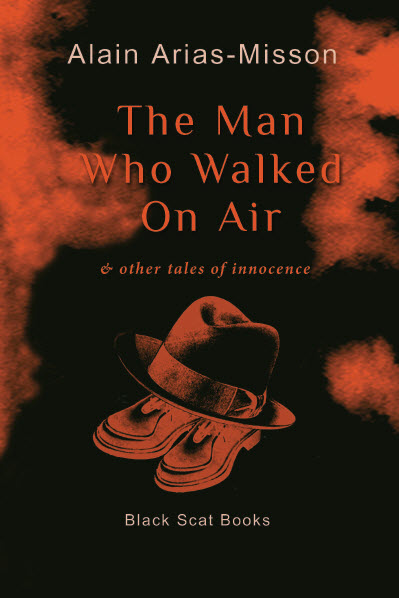
The Man Who Walked On Air & other tales of innocence

air

JUST PUBLISHED: A major new collection of short fiction by Alain Arias-Misson—a master of literary mischief. These fifteen “tales of innocence” are erotic, poetic, mysterious, funny, and always surprising.

ADVANCE PRAISE FOR THE MAN WHO WALKED ON AIR & OTHER TALES OF INNOCENCE

“The title story of Arias-Misson’s The Man Who Walked on Air is emblematic of the fiction collection. Ruminative, cultivated, formally venturesome, smoothly (but not slickly) written, and erotic—a nuanced eroticism that takes deliciously improbable turns. A daring collection in its way, yet always engaging.”
–Harold Jaffe

“Augustus, Alain Arias-Misson’s alter ego in the book, levitates when he has an erection. Arias-Misson levitates when he writes. Take the hand he offers you. He will lead you above the coarseness and banality of much of contemporary writing to a delightfully innocent world of erotic fantasies.”
–Yuriy Tarnawsky, author of Short Tails

Order the book on Amazon

Our Man in Panama

panamaThe legendary literary maestro, Alain Arias-Misson, has disappeared from Paris. Well, no, that’s not quite accurate… he hasn’t vanished in the sense that, say, a CIA operative might suddenly leave the scene. No…Alain is basking in the balmy breezes in Panama. He and the lovely Karen avoid the nasty winters in France by disappearing  (escaping) to their undisclosed hideout (is there any other kind?) on the Pacific. Actually, their hideout looks like a love-nest, oui?

At the Black Scat Books bunker in northern California, we’re all rather jealous of M. Arias-Misson since temperatures have dipped to 30-degrees! In other words we’re freezing our butts off but cannot afford to escape.

To make matters worse, Arias-Misson sends taunting emails from Panama wishing us warm regards, etc. We took revenge, however, and made certain his vacation was interrupted by a lot of work, i.e., we gave him stiff deadlines for compiling his collection of short stories: The Man Who Walked on Air & Other Tales of Innocence. 

This, by the way, is a significant edition featuring 15 “innocent” tales, spanning 195 pages — experimental, erotic, poetic, passionate, obsessive, and hilarious. But that’s stating the obvious… damn it, the man is bloody brilliant and we’re honored to be unleashing the book any moment now. (No joke, check back here today.)

Why a winter pub date you ask?

Once the new book rears its head on Amazon in the U.S. and Europe, the author will head to New York where he’s always in demand for readings and performances.

And NYC is cold as hell in winter.

🙂

Laughter & Cheer for the New Year!

A Cami Sampler

We proudly present a New Year’s treat—#9 in our Absurdist Texts & Documents series: A CAMI SAMPLER, translated from the French by John Crombie in Paris. The collection includes 10 zany, Dadaesque microdramas by Pierre Henri Cami, plus nine pages of his rare drawings. This is the first collection of Cami’s mini plays to be published in the U.S.

From the introduction by John Crombie:

“Though blissfully ignored for most of his life by the
English-speaking public, Cami (Pierre Henri) remained
for four full decades one of France’s most prolific,
and acclaimed, comic authors. Hailed by his idol and
admirer Charlie Chaplin as ‘the greatest humorist in the
world,’ Cami was somewhat willfully omitted by André
Breton from his Anthologie de l’Humour Noir—no doubt
on account of his huge popular success—but admired
by other Surrealists. Between 1910, when he founded
Le Petit Corbillard Illustré, the ‘humorous organ of the
corporation of undertakers,’ and his death in 1958,
Cami published well over forty volumes of minidramas
and comic novels—notably The Memoirs of God-the-
Father, The Adventures of Loufock-Holmes, The Son of
the Three Musketeers, and the travels of his perhaps most
famous creation, Monsieur Rikiki and the Rikiki family—
as well as countless songs, strip cartoons, screenplays
and even operettas. Many of these he also illustrated.

But Cami was best known for his ‘dramatic fantasies,’
written mostly for La Vie Drôle, the humorous column
published weekly by Le Journal, where he had stepped,
somewhat belatedly, into the shoes of that column’s
immortal co-founder, Alphonse Allais. Self-styled
microdramas of everyday life, of legend, of history
(and even of geography), of true (and false) romance,
and more often than not of volupté, these screwball
skits look backward to the music hall and Alfred Jarry,
sideways to the Marx Brothers and forward to, in
England, the Goons and, in France, to the Theatre
of the Absurd.”

Edition limited to 100 copies.

THIS BOOK IS OUT OF PRINT

Grok Gracq

GROK

I discovered the surrealist novels of Julian Gracq many years ago. I encountered an out of print copy of A Dark Stranger at Gotham Book Mart in NYC. Gotham was my home away from home. It specialized in avant-garde literature and carried books you couldn’t find anywhere else: rare chapbooks, pamphlets, and esoteric tomes.

wisemen

This hardcover edition of Gracq’s novel was published in 1951 by New Directions. It was one of those rare books with an aura that compels one to possess it. (an experience you don’t find with a digital book.) The cover design by Gertrude Huston  cleverly omitted the title and author’s name, conjuring a faceless stranger.

gracq-dark-stranger

image courtesy of 50 Watts

One surrealist oddity—although obviously unintentional—was that the title on the flap (as well as the spine) was printed as The Dark Stranger, while the title page correctly identified it as A Dark Stranger.

An anomaly like that can drive up the value of an edition—especially when there are multiple printings.

One of the pleasures of publishing is providing readers with the potential of experiencing the aura of unusual books. Eccentric art and literature that doesn’t surface on the shelves at Barnes & Noble.