We don’t like to play favorites and with a list of some 200 titles we can’t. But we thought you might like to know which titles have been the most popular. So here is a list of our Top Ten. All are in print, so if you missed one just click on its cover.
10 Oulipo Pornobongo (2016)
9 Le Scat Noir Encyclopedie et Dictionaire (2020)
8 Captain Cap, Alphonse Allais (2013)
7 Le Scat Noir Encyclopedia (2017)
6 Critics & My Talking Dog, Stefan Themerson (2019)
“A work exuding such inventiveness, playfulness, humor, and heart, it dazzles the imagination.” —Jeff Weisman, author of The Greatest Place on Earth
“A novella for our times, the author illuminates a world of uncertainty, misfortune, and absurdity with astonishing accuracy, simultaneously crafting a powerful and compelling story infused with hope and humor in his signature style.” —Adrienne Auvray
Apollo Camembert’s first novel, The Isolate, tells the tale of a man who has become so fed up with city life that he holes himself up in stealth housing to avoid all personal contact with the outside world. Unfortunately, the outside world has some nasty tricks up its sleeve.
We could say more, but that would risk giving too much away and we don’t want to spoil the fun. What we can reveal is that “Apollo Camembert” is the brainchild (and nom de plume) of Eckhard Gerdes who, after writing his gargantuan The Chronicles of Michel du Jabot, began composing shorter works, i.e., novellas and flash fictions, including two recent releases from Black Scat: Marco & Iarlaith and The Pissers’ Theatre.
We invite you to escape into Camembert’s quirky fictional world — a world you won’t soon forget.
THE ISOLATE a novel by Apollo Camembert paperback; 132 pp., $12.95 ISBN 979-8-9869224-6-1
Praise for Eckhard Gerdes’ THE CHRONICLES OF MICHEL DU JABOT
“Whatever you do, don ´t even look into Eckhard Gerdes’ book, The Chronicles of Michel du Jabot, because you’ll never get out of it again! If J. Joyce were to be reincarnated—and instead of writing in his inextricably reinvented and rather illegible (without the help of an East European multi-lingual scholar) Panglish, were to practice an altogether clear and charmingly grammatical English as here (admittedly with a scatter of soft linguistic implosions but few)—he would have written this book. It will take generations of English professors to sort it out. Hilarious semantic sport. And don’t expect me to tell you what it is about. I would have to give you a involuted idio-semantic analysis with innumerable brackets and labels, which wouldn’t help anyway. No, okay then, dare to tip-toe into the cavernous echoing brain-chamber of Gerdes’ The Chronicles and if you’re lucky you’ll come tumbling out into the dull everydaylight with a mad enlightened gleam in your eyes and will never read another novel. Yes, this- not Finnegans Wake—is the novel to end the novel.” —Alain Arias-Misson, author of Autobiography of a Character from Fiction
In this rare novella by the Marquis de Sade, a marriage is arranged between the aging Judge de Fontanis and a young woman, Mademoiselle de Téroze, who (unbeknownst to him) is in love with someone else. The young woman and her brother-in-law (the Marquis d’Olincourt) perpetrate a series of practical jokes, humiliating hoaxes and elaborate schemes in order to deceive the judge and stop him from consummating the marriage.
This amusing tale is an artfully-written and beautifully-structured literary attack on the judiciary, and one of Sade’s most savagely satirical texts.
A JUDGE DECEIVED Marquis de Sade Translated from the French by R J Dent Pocket Erotica #24 pp., 174; paper, $14.95
Two other humorous works by the Marquis de Sade are also available in the Pocket Erotica series.
Those familiar with Tom Whalen’s writing will have already skipped this sentence and jumped to the “buy now” button below. For those who have yet to experience his short fictions, you’re in for a treat.
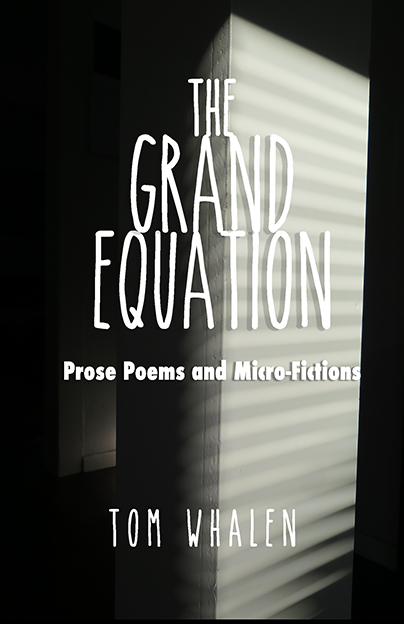
In Tom Whalen’s Grand Equation ants make their way to the edge of the universe, an old doll rocks her nights away in the attic of an abandoned theater shop, “delivery trucks rumble up from the earth,” flies “feast off the flytrap of the sky,” a room falls in love with its inhabitant, and a man gives birth to a puppet. Populating the whole are troubled old men, grandmothers, a green man and priests, as well as dolls, mice, prose poets, and other fabular fauna. Drawn from Whalen’s work in the field over the past five decades, the sixty-seven prose poems and micro-fictions of The Grand Equation are comic, surreal, philosophical, disquieting and, as John Taylor commented in Michigan Quarterly Review on Whalen’s “Why I Hate the Prose Poem,” “particularly subtle.”
Reading Tom Whalen’s Grand Equation, I am reminded of my early years of writing prose poetry and reading the great masters of the form including Baudelaire, Jacob, Edson, Tate, and Simic. Like the great prose poets before him, Whalen’s work is startling, witty, surreal, and metaphysical. He uses the form to enchant and to entertain, to describe other worlds and offer new windows onto this one. His images, parables, and insights make the absurd seem ordinary and vice versa. And remind me that the world is not as I imagine it to be, and neither am I. This is a collection to ponder, savor and return to.
—NIN ANDREWS, author of The Last Orgasm
THE GRAND EQUATION Prose Poems and Micro-Fictions Tom Whalen $14.95 paperback ISBN 979-8-9859996-8-6
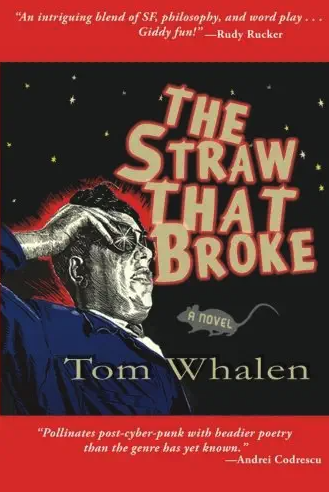
Tom Whalen’s short prose has appeared in Great American Prose Poems, Sudden Fiction, An Introduction to the Prose Poem, The Best of the Prose Poem, A Cast-Iron Aeroplane That Can Actually Fly, Unscheduled Departures, The Party Train and other anthologies. His two selections and translations of short prose by Robert Walser — Girfriends, Ghosts, and Other Stories and Little Snow Landscape — are published with NYRB Classics. His novel The Straw That Broke and collection April Fireball: Early Stories are both available from Black Scat.
It’s back to cool with the great French monologist, humorist, poet, and inventor—in a trenchant translation by Doug Skinner.
***FIRST PUBLICATION IN ENGLISH!***
Born in1842, Charles Cros was one of the most brilliant minds of his generation, equally adept at poetry, fiction, and scientific inquiry. He wrote smutty verses with Verlaine, synthesized gems with Alphonse Allais, contributed wild prose fantasies to Le Chat Noir, and experimented with color photography and sound recording, only to die young, poor, and alcoholic. Not incidentally, he also invented the comic monologue for the actor Coquelin Cadet. In these strikingly spontaneous and modern sketches, he introduces a gallery of fools and obsessives—The Clean Man, The Fencing Master, The Capitalist, The Friend of the Family—all nattering away, assaulting the audience with trivia, and blithely unaware of their own failings.
This edition collects all 22 of Cros’s monologues—masterfully translated & introduced by Doug Skinner—and includes performance notes by Coquelin, plus two biographical essays by his friend and colleague Alphonse Allais.
“The sheer playfulness of certain fanciful parts of Cros’s work must not let us forget that in the center of some of his finest poems, a revolver is aimed at us.”—André Breton
ALSO AVAILABLE
Charles Cros and Émile Goudeau were quintessential Bohemian poets of the 1880s. Cros also experimented with the phonograph and color photography; Goudeau founded the Hydropathes, who met to declaim poetry while not drinking water. Cros and Goudeau’s only collaboration was a series of five exuberant stories published in 1880, which satirized such hot topics as divorce and capital punishment with bawdy humor and wild flights of fancy. All five stories are included here, plus four solo stories by Cros that complete the series, translated and annotated by Doug Skinner.
Nominata has gone missing, and her old friend Antonima is looking for her. Can the seven regulars in the Taproom help? Why are there strange lights and noises in the abandoned observatory? And what does the number 5040 have to do with all this?
Doug Skinner describes his novel as “an interactive verbal toy,” and Black Scat urges caution when handling it. On the surface, the text is playful, comic, and wayward. Further immersion, however, reveals elaborate constraints, cross references, and parallels, all creating an artificial world in which everything is a reflection of everything else, including itself. All that and slapstick too!
In 2020, New Urge Editions published Hélène Lavelle‘s controversial erotic novel, The Rites of Ecstasy. Today, we are pleased to announce Volume 2—Le Château du Comte—translated from the French by Valéry Soers.
Summoned back to the Domain, Gabrielle surrenders to the demands of the Vicomtesse, the Comte, and Lady Isabella. Much more than a sequel to The Rites of Ecstasy, this novel takes us beyond the introspective feminine dreaminess of La Maison to a more bracing, hallucinatory, wild and strange terrain of its own—the culmination and climax of ‘the Great Work’ on Gabrielle’s heart, soul, mind and body. A story of dramatic and erotic power – an immersion in another world – exploring the farther shores of female desire, love, hate and friendship, through extremes of pleasure and pain to the heights of the Sublime.
Le Château du Comte by Hélène Lavelle Translated from the French by Valéry Soers A New Urge Paperback Original Trade paper; 315 pp.; $14.95 ISBN 979-8985999648
FREE DOWNLOAD Peek behind the scenes & explore Hélène Lavelle’s novels. Read Dawn Avril Fitzroy’s article “Ruminations on THE RITES OF ECSTASY,” from Black Scat Review#25. Click here to download the free PDF.
ALSO AVAILABLE
In the tradition of Decadent literature, spiced with Gothic, this provocative novel takes the reader on a voyage through dream, reverie, fantasy, memory and imagination – recounting the raptures and tortures in the initiation of a young woman, Gabrielle, by the Vicomtesse, the Comte and their entourage in The Domain.
“This modern classic deserves to be ranked alongside the great French erotic masterpieces, Story of O and The Image , and very few others. Not for the faint-hearted or the narrow-minded, this story of love, excess, degradation, cruelty, tenderness and beauty is for all women whose fantasies and desires embrace the intensely erotic.” —Dawn Avril Fitzroy
Alphonse Allais (1854-1905) was France’s greatest humorist. His elegance, scientific curiosity, preoccupation with language and logic, wordplay and flashes of cruelty inspired Alfred Jarry, as well as succeeding generations of Surrealists, Pataphysicians, and Oulipians.THE SQUADRON’S UMBRELLA collects 39 of Allais’s funniest stories — many originally published in the legendary paper LE CHAT NOIR, written for the Bohemians of Montmartre. Included are such classic pranks on the reader as “The Templars” (in which the plot becomes secondary to remembering the hero’s name) and “Like the Others” (in which a lover’s attempts to emulate his rivals lead to fatal but inevitable results.) These tales have amused and inspired generations, and now English readers can enjoy the master absurdist at his best. As the author promises, this book contains no umbrella and the subject of squadrons is “not even broached.”
This sublime translation by Doug Skinner is one of our most popular titles.
About the Author ALPHONSE ALLAIS (1854 – 1905) began his career in Paris during the Belle Epoque. He was particularly active at the legendary cabaret Le Chat Noir, where he wrote for and edited the weekly paper. He quickly became known for his deadpan wit and inexhaustible imagination. Among other things, he also exhibited some of the first monochromatic pictures (such as his all-white “First Communion of Chlorotic Girls in the Snow” in 1883) and composed the first silent piece of music: “Funeral March for the Obsequies of a Deaf Man” (1884). Throughout most of his life, he contributed columns several times a week to LE JOURNAL and LE SOURIRE. These pieces were collected into twelve volumes, which he called his “Anthumous Works,” between 1892 and 1902. He also published a collection of his monochromes, ALBUM PRIMO-AVRILESQUE, in 1897, and a novel, L’AFFAIRE BLAIREAU, in 1899, as well as a few plays. His later years were troubled by debt, a bad marriage, and heavy drinking; he died at 59. He was a crucial influence on Alfred Jarry, as well as on the Surrealists: Breton included him in his ANTHOLOGY OF BLACK HUMOR, and Duchamp was reading him on the day he died. Allais’s fascination with wordplay, puns, and holorhymes led Oulipo to call him an “anticipatory plagiarist”; the Pataphysical College dubbed him their “Patacessor.” His books have remained in print in France, and the Académie Alphonse Allais has awarded a literary prize in his honor since 1954.
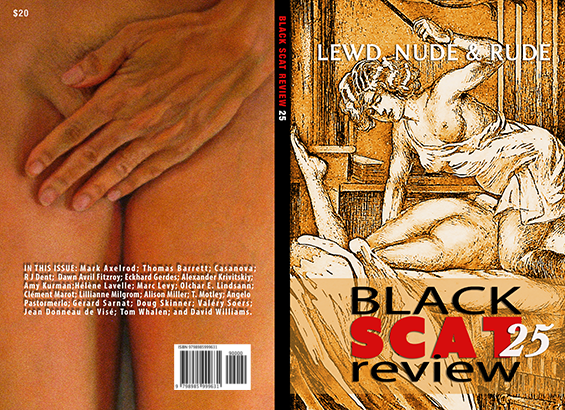
The lovely “Lewd, Nude & Rude” issue of BLACK SCAT REVIEW has stormed the beach!
As you’ve come to expect, the issue is filled with Sublime Art & Literature — innovative fiction, eye-popping graphics, works in translation, and spicy absurdities. Featuring 131 pages packed with an international cast of contributors: Mark Axelrod; Thomas Barrett; Sebastian Bennett; Giacomo Girolamo Casanova; Norman Conquest; R J Dent; Dawn Avril Fitzroy; Eckhard Gerdes; Alexander Krivitskiy; Amy Kurman; Hélène Lavelle; Marc Levy; Olchar E. Lindsann; Clément Marot; Lilianne Milgrom; Alison Miller; T. Motley; Angelo Pastormerlo; GerardSarnat; Doug Skinner; Valéry Soers; Jean Donneau de Visé; Gregory Wallace; Tom Whalen; and David Williams.