
OVER 200 TITLES PUBLISHED, OVER 160 TITLES IN PRINT.
OVER 200 TITLES PUBLISHED, OVER 160 TITLES IN PRINT.
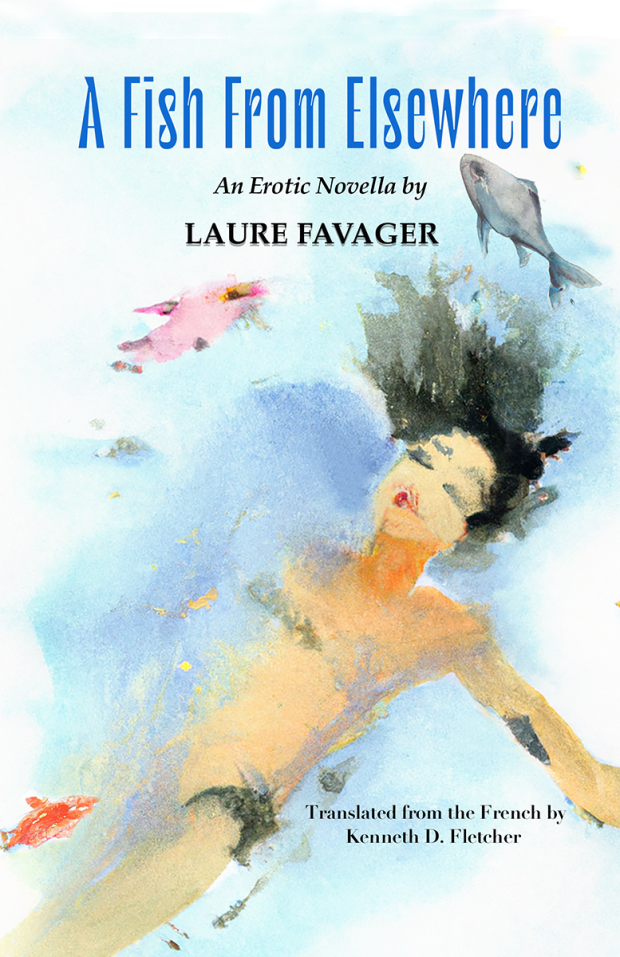
A FISH FROM ELSEWHERE
Eléa follows a strange fish and is thrown into a provocative realm of unabashed sexual gratification. Faced with evading the grip of the law, escaping the intoxicating clutches of l’hôpital du plaisir, and eluding the ire of her parallel lover’s fiancée, she must return home before she fades away altogether.
A startling, surreal, satiric erotic escapade, this raunchy Wonderland is imbued with the spirit of Kafka, Nin, and Terry Southern.
Laure. Favager’s style is engaging and disruptive, transporting readers into a surreal world where the lines between reality and sexual fantasy blur. The author’s vivid and explicit prose create a comic atmosphere that is both sexy and unsettling, immersing the reader in Eléa’s increasingly erotic escapades.

ABOUT THE AUTHOR

Laure Favager’s short fiction has appeared in several literary journals in France and Quebec. This is her first publication in the U.S.
She lives in Brittany with two uninhibited cats.
UPDATE: Laure Favager’s The Desire Box is now available from New Urge.


We’re pleased as punch to bring you the 14th volume in our Alphonse Allais Collection—Let’s Not Hit Each Other, the last of the master absurdist’s anthumous works. It features 58 tales, rife with wordplay and wicked humor. This collection has been skillfully translated by Doug Skinner and includes his introduction and illuminating notes on the text.
What are we to make of Let’s Not Hit Each Other?
It includes a flying whale, an inflatable colonel, telepathic snails, a summer crime, the insularization of France, missionary parrots, an amphibious herring, twin cousins, and proposals for billboard dogs, deodorized urine, calming the sea with varnish, and crossing the English Channel with swings. You will also meet Mr. Fish, who travels with capsules of American air, presaging Duchamp’s “Paris Air” by decades.
This is the FIRST ENGLISH TRANSLATION of a remarkable volume. This edition includes an original portrait of the author by Corinne Taunay.
“One does not trifle with the humor of Allais.”
—Jean-Pierre Delaune

We don’t like to play favorites and with a list of some 200 titles we can’t. But we thought you might like to know which titles have been the most popular. So here is a list of our Top Ten. All are in print, so if you missed one just click on its cover.


In this rare novella by the Marquis de Sade, a marriage is arranged between the aging Judge de Fontanis and a young woman, Mademoiselle de Téroze, who (unbeknownst to him) is in love with someone else. The young woman and her brother-in-law (the Marquis d’Olincourt) perpetrate a series of practical jokes, humiliating hoaxes and elaborate schemes in order to deceive the judge and stop him from consummating the marriage.
This amusing tale is an artfully-written and beautifully-structured literary attack on the judiciary, and one of Sade’s most savagely satirical texts.
A JUDGE DECEIVED
Marquis de Sade
Translated from the French by R J Dent
Pocket Erotica #24
pp., 174; paper, $14.95
Two other humorous works by the Marquis de Sade are also available in the Pocket Erotica series.
 |  |
Good Scat for the New Year. Give them something different. Just click & buy.




Originally released in a limited edition, this vastly expanded version of Black Scat’s Merde à La Belle Époque brings gastric laughter to all of America. This hilarious scatological anthology features verses, stories, songs, and playlets by some of Paris’s most inventive and eccentric comic writers of the period. It includes the exceedingly rare Le Journal des Merdeux — an illustrated broadside devoted entirely to merde. Indeed, upon its publication in 1882, The Little Shits’ Journal was seized by the police and banned. Merde!
This lovely, deodorized paperback edition, designed by Norman Conquest, has been exquisitely compiled, deftly translated, and introduced by Doug Skinner, and includes his erudite and witty notes on the texts.
Return to those raucous years of La Belle Époque when French “shiterature” scandalized Paris.


Alphonse Allais (1854-1905) was France’s greatest humorist. His elegance, scientific curiosity, preoccupation with language and logic, wordplay and flashes of cruelty inspired Alfred Jarry, as well as succeeding generations of Surrealists, Pataphysicians, and Oulipians. THE SQUADRON’S UMBRELLA collects 39 of Allais’s funniest stories — many originally published in the legendary paper LE CHAT NOIR, written for the Bohemians of Montmartre. Included are such classic pranks on the reader as “The Templars” (in which the plot becomes secondary to remembering the hero’s name) and “Like the Others” (in which a lover’s attempts to emulate his rivals lead to fatal but inevitable results.) These tales have amused and inspired generations, and now English readers can enjoy the master absurdist at his best. As the author promises, this book contains no umbrella and the subject of squadrons is “not even broached.”
This sublime translation by Doug Skinner is one of our most popular titles.

About the Author
ALPHONSE ALLAIS (1854 – 1905) began his career in Paris during the Belle Epoque. He was particularly active at the legendary cabaret Le Chat Noir, where he wrote for and edited the weekly paper. He quickly became known for his deadpan wit and inexhaustible imagination. Among other things, he also exhibited some of the first monochromatic pictures (such as his all-white “First Communion of Chlorotic Girls in the Snow” in 1883) and composed the first silent piece of music: “Funeral March for the Obsequies of a Deaf Man” (1884). Throughout most of his life, he contributed columns several times a week to LE JOURNAL and LE SOURIRE. These pieces were collected into twelve volumes, which he called his “Anthumous Works,” between 1892 and 1902. He also published a collection of his monochromes, ALBUM PRIMO-AVRILESQUE, in 1897, and a novel, L’AFFAIRE BLAIREAU, in 1899, as well as a few plays. His later years were troubled by debt, a bad marriage, and heavy drinking; he died at 59. He was a crucial influence on Alfred Jarry, as well as on the Surrealists: Breton included him in his ANTHOLOGY OF BLACK HUMOR, and Duchamp was reading him on the day he died. Allais’s fascination with wordplay, puns, and holorhymes led Oulipo to call him an “anticipatory plagiarist”; the Pataphysical College dubbed him their “Patacessor.” His books have remained in print in France, and the Académie Alphonse Allais has awarded a literary prize in his honor since 1954.

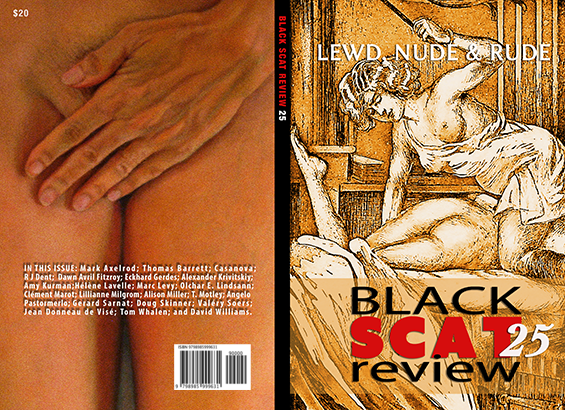
The lovely “Lewd, Nude & Rude” issue of BLACK SCAT REVIEW has stormed the beach!
As you’ve come to expect, the issue is filled with Sublime Art & Literature — innovative fiction, eye-popping graphics, works in translation, and spicy absurdities. Featuring 131 pages packed with an international cast of contributors: Mark Axelrod; Thomas Barrett; Sebastian Bennett; Giacomo Girolamo Casanova; Norman Conquest; R J Dent; Dawn Avril Fitzroy; Eckhard Gerdes; Alexander Krivitskiy; Amy Kurman; Hélène Lavelle; Marc Levy; Olchar E. Lindsann; Clément Marot; Lilianne Milgrom; Alison Miller; T. Motley; Angelo Pastormerlo; Gerard Sarnat; Doug Skinner; Valéry Soers; Jean Donneau de Visé; Gregory Wallace; Tom Whalen; and David Williams.
Have a bang-up Memorial Day!
“As with Joyce Carol Oates’s Blonde, Harold Jaffe’s Brando Bleeds is the best kind of biographical fiction — perceptive, inventive, richly thematic, and truer than true. That his concisely rendered composite of Brando gives us such a full portrait of its subject is nothing short of a miracle.” —Tom Whalen
BRANDO BLEEDS
A Novel by Harold Jaffe
Paperback; 181 pp., $14.95
ISBN 979-8985999655
Each of Jaffe’s volumes has been groundbreaking. He has written some of the most innovative fiction of our time. —Toby Olson
EROS ANTI-EROS is… a wonder of deadpan humor, biting wit and visual beauty. No recent fiction has gripped me with such force and immediacy. —Marianne Hauser
From the docufictional shards of GOOSESTEP emerges a savage prophetic voice as grief-maddened as Isis picking through the bones on illusion’s killing floor to reassemble a dream that cannot be reanimated. —Patricia Eakins
As TERROR-DOT-GOV vividly demonstrates: We are spiritually imperiled by illusions masked as “news.” Omissions, slants, pallid editorials all testifying to servitude to a slavish, enslaving “text.” Harold Jaffe knows this by heart. Everywhere in Terror-dot-Gov, is exemplary skill, faultless tonality, and courage. Don’t forget courage. —Daniel Berrigan, SJ
The bravura essays in Harold Jaffe’s collection, REVOLUTIONARY BRAIN, challenge the conscience and consciousness of their readers. This witty and explosive book is an indictment of injustice and spurious morality and a call to art and enlightened activism as healing alternatives. —Jonathan Baumbach
Harold Jaffe’s SACRIFICE is an omnidirectional cry of alarm and call to action…[his] adept prose is a heart-filled and intellectualized reaction to terrestrial issues, a combination of rage, revulsion, and an implied plea for amelioration—in the fullest form of self-sacrifice. —Sebastian Bennett
“Jaffe’s convincing portraits of the dispossessed are moving, insightful glimpses of the human spirit under stress.” —New York Times Book Review
As always, Jaffe’s writing is moving, comical, marvelously deft.” —Washington Post

 blackscatbooks.com