Nominata has gone missing, and her old friend Antonima is looking for her. Can the seven regulars in the Taproom help? Why are there strange lights and noises in the abandoned observatory? And what does the number 5040 have to do with all this?
Doug Skinner describes his novel as “an interactive verbal toy,” and Black Scat urges caution when handling it. On the surface, the text is playful, comic, and wayward. Further immersion, however, reveals elaborate constraints, cross references, and parallels, all creating an artificial world in which everything is a reflection of everything else, including itself. All that and slapstick too!
In 2020, New Urge Editions published Hélène Lavelle‘s controversial erotic novel, The Rites of Ecstasy. Today, we are pleased to announce Volume 2—Le Château du Comte—translated from the French by Valéry Soers.
Summoned back to the Domain, Gabrielle surrenders to the demands of the Vicomtesse, the Comte, and Lady Isabella. Much more than a sequel to The Rites of Ecstasy, this novel takes us beyond the introspective feminine dreaminess of La Maison to a more bracing, hallucinatory, wild and strange terrain of its own—the culmination and climax of ‘the Great Work’ on Gabrielle’s heart, soul, mind and body. A story of dramatic and erotic power – an immersion in another world – exploring the farther shores of female desire, love, hate and friendship, through extremes of pleasure and pain to the heights of the Sublime.
Le Château du Comte by Hélène Lavelle Translated from the French by Valéry Soers A New Urge Paperback Original Trade paper; 315 pp.; $14.95 ISBN 979-8985999648
FREE DOWNLOAD Peek behind the scenes & explore Hélène Lavelle’s novels. Read Dawn Avril Fitzroy’s article “Ruminations on THE RITES OF ECSTASY,” from Black Scat Review#25. Click here to download the free PDF.
ALSO AVAILABLE
In the tradition of Decadent literature, spiced with Gothic, this provocative novel takes the reader on a voyage through dream, reverie, fantasy, memory and imagination – recounting the raptures and tortures in the initiation of a young woman, Gabrielle, by the Vicomtesse, the Comte and their entourage in The Domain.
“This modern classic deserves to be ranked alongside the great French erotic masterpieces, Story of O and The Image , and very few others. Not for the faint-hearted or the narrow-minded, this story of love, excess, degradation, cruelty, tenderness and beauty is for all women whose fantasies and desires embrace the intensely erotic.” —Dawn Avril Fitzroy
Alphonse Allais (1854-1905) was France’s greatest humorist. His elegance, scientific curiosity, preoccupation with language and logic, wordplay and flashes of cruelty inspired Alfred Jarry, as well as succeeding generations of Surrealists, Pataphysicians, and Oulipians.THE SQUADRON’S UMBRELLA collects 39 of Allais’s funniest stories — many originally published in the legendary paper LE CHAT NOIR, written for the Bohemians of Montmartre. Included are such classic pranks on the reader as “The Templars” (in which the plot becomes secondary to remembering the hero’s name) and “Like the Others” (in which a lover’s attempts to emulate his rivals lead to fatal but inevitable results.) These tales have amused and inspired generations, and now English readers can enjoy the master absurdist at his best. As the author promises, this book contains no umbrella and the subject of squadrons is “not even broached.”
This sublime translation by Doug Skinner is one of our most popular titles.
About the Author ALPHONSE ALLAIS (1854 – 1905) began his career in Paris during the Belle Epoque. He was particularly active at the legendary cabaret Le Chat Noir, where he wrote for and edited the weekly paper. He quickly became known for his deadpan wit and inexhaustible imagination. Among other things, he also exhibited some of the first monochromatic pictures (such as his all-white “First Communion of Chlorotic Girls in the Snow” in 1883) and composed the first silent piece of music: “Funeral March for the Obsequies of a Deaf Man” (1884). Throughout most of his life, he contributed columns several times a week to LE JOURNAL and LE SOURIRE. These pieces were collected into twelve volumes, which he called his “Anthumous Works,” between 1892 and 1902. He also published a collection of his monochromes, ALBUM PRIMO-AVRILESQUE, in 1897, and a novel, L’AFFAIRE BLAIREAU, in 1899, as well as a few plays. His later years were troubled by debt, a bad marriage, and heavy drinking; he died at 59. He was a crucial influence on Alfred Jarry, as well as on the Surrealists: Breton included him in his ANTHOLOGY OF BLACK HUMOR, and Duchamp was reading him on the day he died. Allais’s fascination with wordplay, puns, and holorhymes led Oulipo to call him an “anticipatory plagiarist”; the Pataphysical College dubbed him their “Patacessor.” His books have remained in print in France, and the Académie Alphonse Allais has awarded a literary prize in his honor since 1954.
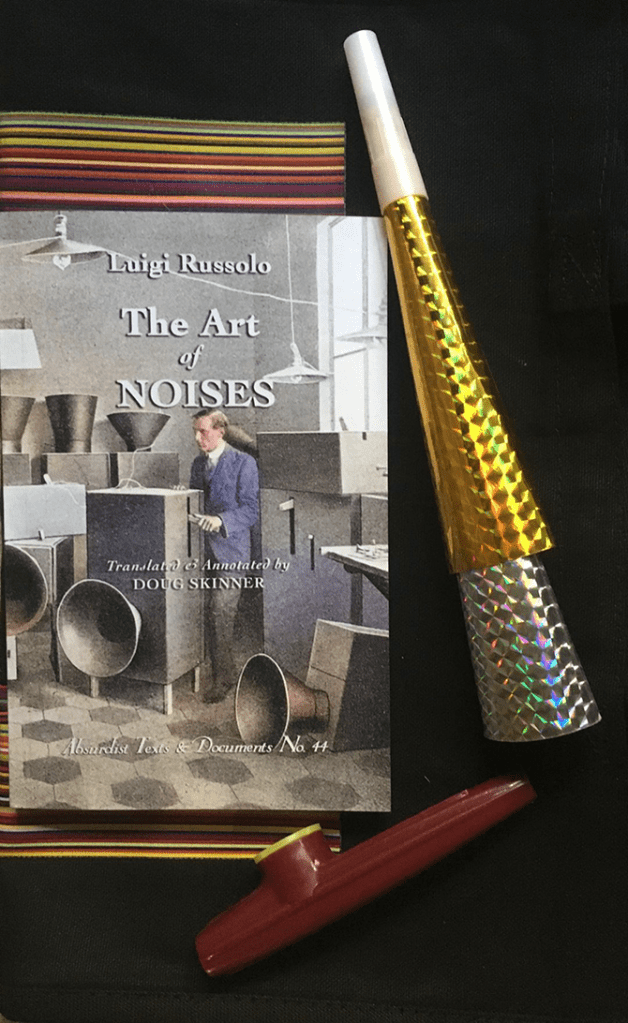
The Fourth of July is a noisy holiday, and this year it’s going to be even noisier, as it’s Black Scat’s 10th anniversary.Thus, it’s fitting that we’ve launched Luigi Russolo‘s Italian Futurist classic, THE ART OF NOISES, in a new translation by Doug Skinner. The book includes a seminal introduction by Skinner, as well as his copious notes on the translation. Originally released in Milan by Edizioni Futuriste di Poesia in 1916, this text was a sonic boom that awakened 20th-century avant-garde musical aesthetics and inspired generations of experimental composers.
In the words of Daniel Matei, it was THE ART OF NOISES that “elevated Russolo to the level of Marinetti and Boccioni.”
Artist Norman Conquest has designed our edition and crafted a near facsimile of the original Italian volume, while adding a few obstreperous flourishes of his own. We hope you’ll celebrate Scat’s ten years by ordering a copy of this gem — #44 in our legendary Absurdist Texts & Documents series.
Have a BLAST this summer and make some noise!
THE ART OF NOISES Luigi Russolo Translated from the Italian by Doug Skinner Absurdist Texts & Documents No. 44 —A Zang Tumb Tumb Edition— Paperback, illustrated; 134 pp., $15 ISBN: 979-8-9859996-2-4
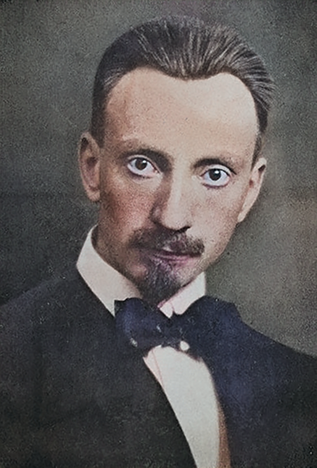
Luigi RussoloDancin’ to the NoiseRussolo at the Russolophone
ABOUT THE AUTHOR Luigi Russolo (1885-1947) was born into a musical family in Portogruaro, Italy. As a child, he studied violin and piano, but decided to switch to painting. When F. T. Marinetti launched Futurism in 1909, Russolo soon became one of its principal members. In 1913, he wrote a manifesto, “L’Arte dei rumori” (“The Art of Noises”), proclaiming a new music based on noises; he spent the next few years building instruments, giving concerts, and expanding his manifesto into a book. A war injury in 1917 slowed him down, but he continued painting and giving concerts throughout the ‘20s, as well as building several “noise harmoniums.” In the ‘30s he became interested in the occult, and wrote a long philosophical dialogue called Al di là della materia (Beyond Matter), arguing for a society based on spirituality. He died in 1947. Although his scores and instruments were lost in World War II, his ideas continue to fascinate and influence many musicians.
ABOUT THE TRANSLATOR Doug Skinner has translated many books from the French and Italian, including works by Alphonse Allais, Pierre-Corneille Blessebois, Caroline Crépiat, Charles Cros, Alfred Jarry, and Giovanni Battista Nazari. Black Scat has published several books of his fiction (Sleepytime Cemetery, The Snowman Three Doors Down), cartoons (The Unknown Adjective, Shorten the Classics), and music (The Doug Skinner Songbook). He has contributed to The Fortean Times, Strange Attractor Journal, Cabinet, Fate, Weirdo, Nickelodeon, Black Scat Review, and other fine periodicals. His musical activities include scores for dance (ODC-San Francisco, Margaret Jenkins), as well as several shows by actor/clown Bill Irwin, including The Regard of Flight, The Courtroom, and The Harlequin Studies; his albums That Regrettable Weekend and It All Went Pfft are available on Bandcamp.
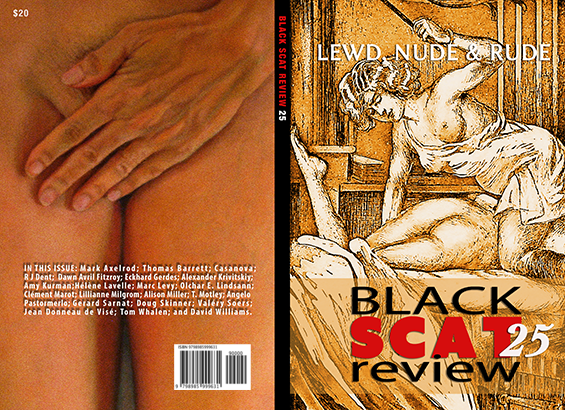
The lovely “Lewd, Nude & Rude” issue of BLACK SCAT REVIEW has stormed the beach!
As you’ve come to expect, the issue is filled with Sublime Art & Literature — innovative fiction, eye-popping graphics, works in translation, and spicy absurdities. Featuring 131 pages packed with an international cast of contributors: Mark Axelrod; Thomas Barrett; Sebastian Bennett; Giacomo Girolamo Casanova; Norman Conquest; R J Dent; Dawn Avril Fitzroy; Eckhard Gerdes; Alexander Krivitskiy; Amy Kurman; Hélène Lavelle; Marc Levy; Olchar E. Lindsann; Clément Marot; Lilianne Milgrom; Alison Miller; T. Motley; Angelo Pastormerlo; GerardSarnat; Doug Skinner; Valéry Soers; Jean Donneau de Visé; Gregory Wallace; Tom Whalen; and David Williams.
“As with Joyce Carol Oates’s Blonde, Harold Jaffe’s Brando Bleeds is the best kind of biographical fiction — perceptive, inventive, richly thematic, and truer than true. That his concisely rendered composite of Brando gives us such a full portrait of its subject is nothing short of a miracle.” —Tom Whalen
As BLACK SCAT approaches its 10th anniversary (July 4th), we’re excited to announce the publication of a major new novel by Harold Jaffe—one of America’s most innovative writers and thinkers.
BRANDO BLEEDS is a “docufictional” version of the life of renegade cultural icon Marlon Brando. Harold Jaffe seamlessly weds biographical fact and fiction, breathing new life into Brando as shaman/showman, an anti-Hollywood “movie star” whose radical politics forced him to confront the inevitable contradiction between rebel/activist and capitalist avatar. Drawn from biographical sources and Brando’s films, the author unveils Brando as a unique artist who both witnesses and introjects the world in pain.
BRANDO BLEEDS A Novel by Harold Jaffe Paperback; 181 pp., $14.95 ISBN 979-8985999655
CRITICAL PRAISE FOR HAROLD JAFFE
Each of Jaffe’s volumes has been groundbreaking. He has written some of the most innovative fiction of our time. —Toby Olson
EROS ANTI-EROS is… a wonder of deadpan humor, biting wit and visual beauty. No recent fiction has gripped me with such force and immediacy. —Marianne Hauser
From the docufictional shards of GOOSESTEP emerges a savage prophetic voice as grief-maddened as Isis picking through the bones on illusion’s killing floor to reassemble a dream that cannot be reanimated. —Patricia Eakins
As TERROR-DOT-GOV vividly demonstrates: We are spiritually imperiled by illusions masked as “news.” Omissions, slants, pallid editorials all testifying to servitude to a slavish, enslaving “text.” Harold Jaffe knows this by heart. Everywhere in Terror-dot-Gov, is exemplary skill, faultless tonality, and courage. Don’t forget courage.—Daniel Berrigan, SJ
The bravura essays in Harold Jaffe’s collection, REVOLUTIONARYBRAIN, challenge the conscience and consciousness of their readers. This witty and explosive book is an indictment of injustice and spurious morality and a call to art and enlightened activism as healing alternatives. —Jonathan Baumbach
Harold Jaffe’s SACRIFICE is an omnidirectional cry of alarm and call to action…[his] adept prose is a heart-filled and intellectualized reaction to terrestrial issues, a combination of rage, revulsion, and an implied plea for amelioration—in the fullest form of self-sacrifice. —Sebastian Bennett
“Jaffe’s convincing portraits of the dispossessed are moving, insightful glimpses of the human spirit under stress.” —New York Times Book Review
As always, Jaffe’s writing is moving, comical, marvelously deft.” —Washington Post
As the first publisher to bring many books by France’s greatest humorist to America — in sublime translations by Doug Skinner — we are happy to share the exceedingly rare photo below. It was recently unveiled by the Musée Alphonse Allais in Honfleur (Allais’s birthplace) and donated by Nicole et Xavier Artus. It shows Alphonse with his wife, Marguerite, and daughter, Paulette, at “La Ferme de la grande cour” (circa 1896). Of the location, Allais wrote: “I go there often, to this rustic inn, half farm, half hotel; I go there to drink a glass of fresh cider, under the apple trees and even have a bite to eat when the heart tells me…”
Below, we have taken the liberty of colorizing the photograph and improving its exposure. We think it brings the image to life.
Happy May Day to Allais and to all our visitors. Help us celebrate by ordering one of the master’s collections here.
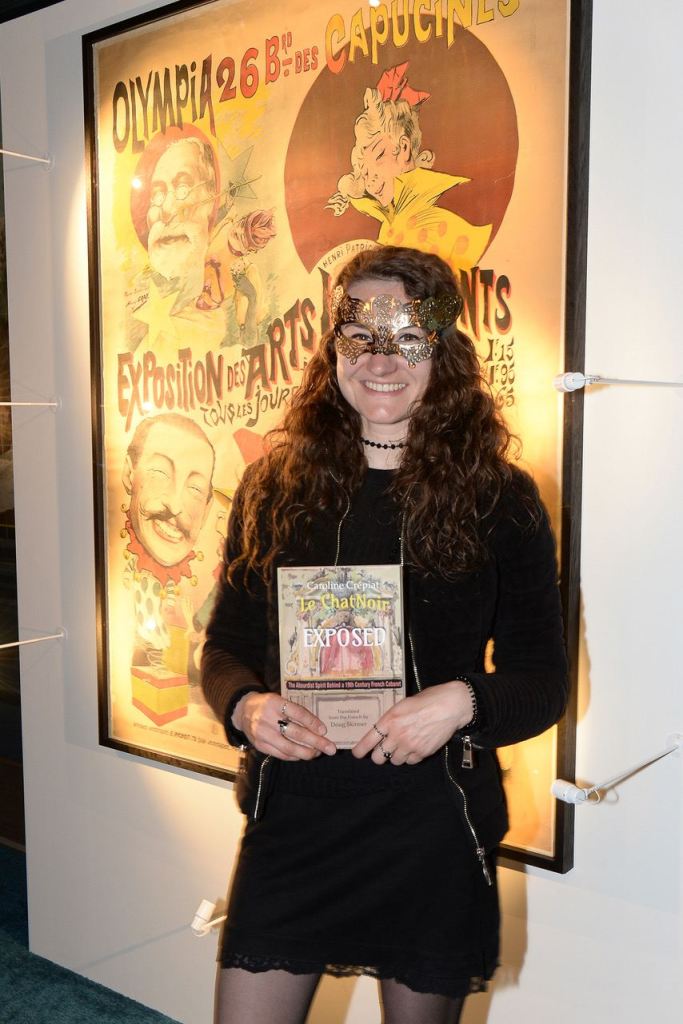
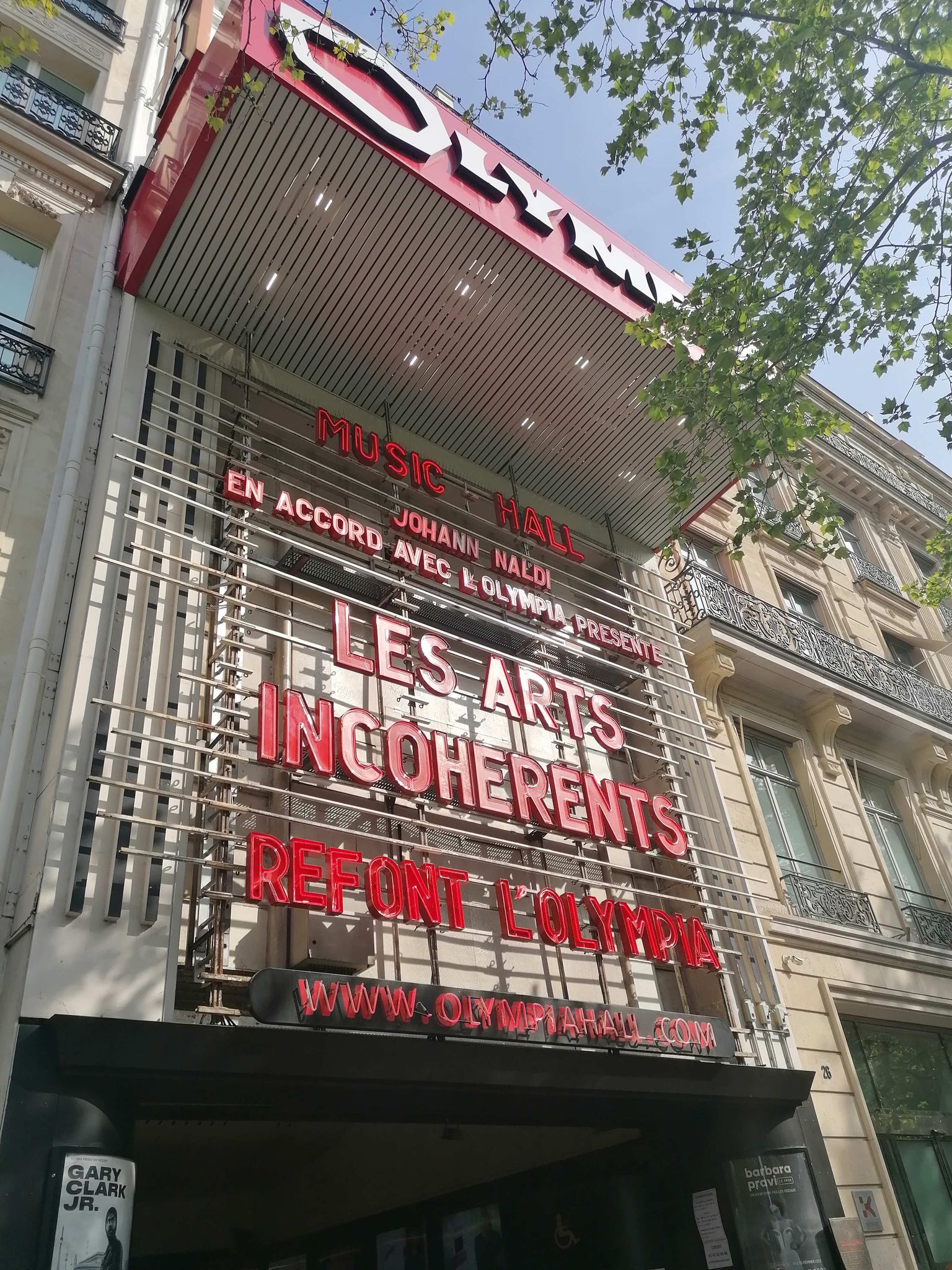
Black Scat author Caroline Crépiat poses with her edition of LE CHAT NOIR EXPOSED at the recent exposition of Incohérents art at the l’Olympia in Paris. A true funhouse of exhibits and quite a scandal still, just as the early exposition in 1893 shocked the city. The Incoherents were irrational, satirical, iconoclastic and absurdist, but were they artists asked the public? “Mais oui,” exclaimed Jules Lévy, the founder of the Incoherent Art movement, “but these artists don’t know how to draw.” (haha)
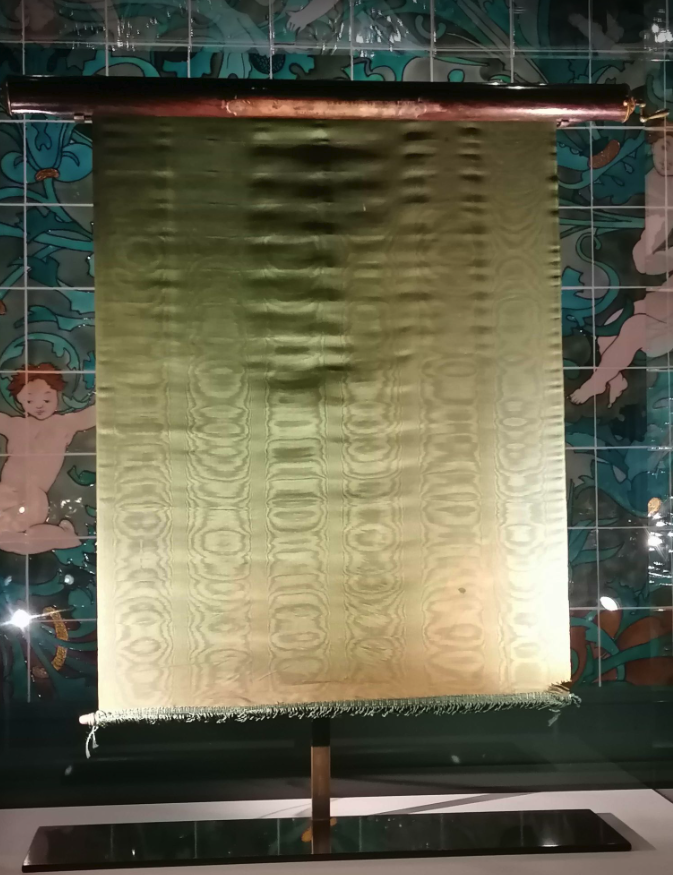
Imagine the gasps of attendees when they spied Alphonse Allais‘s green cab curtain, titled Des souteneurs, encore dans la force de l’âge et le ventre dans l’herbe, boivent de l’absinthe (Pimps still in the prime of life and lying face down in the grass drink absinthe)—one of the earliest monochromes in the history of art!—shocking indeed.
Most of the original Incoherent’s artworks & ephemera did not survive, and could only be seen in 19th century illustrations. But then, in 2021, came a remarkable discovery in France — a large trunk with 17 examples of art by Incoherents, including Allais’s monochrome.
But wait…were these artworks real, or fakes and forgeries? And why was the show limited to only 4 hours of viewing?? (What next? A drive-thru exhibition?)
Experts, such as our friend, artist and critic, Corinne Taunay, have been investigating and discovered that several items (including Allais’s curtain!) aren’t authentic. Mon dieu! — another scandal rocks the Parisienne artworld! This brazen scam appears designed to reap enormous profit (10 million euros, anyone?) off the memory of dead avant-garde rebels.
Meanwhile, here in America where everything is branded “fake” today, we remain respectfully silent on the controversy. However, what we can guarantee is the authenticity of Ms. Crépiat’s LE CHAT NOIR EXPOSED. Indeed, her book is the real deal — translated from the French by the great Doug Skinner — an extraordinary work of scholarship that ‘exposes’ the liveliest fin-de-siècle bohemian cabaret and journal in Paris.
SACRIFICE is perhaps Harold Jaffe’s most personal book, while at the same time assaulting the assaulters of an earth in its final throes. As always, the assaults are brilliantly multi-faceted: “unsituated” dialogues, razor-sharp satire, faux-reportage, precisely cadenced rhetoric, and a deep spirit-feeling for the disappeared and dispossessed—human, animal, and plant.
Each of Jaffe’s volumes has been groundbreaking. He has written some of the most innovative fiction of our time. —Toby Olson
Harold Jaffe’s latest work, Sacrifice, is an omnidirectional cry of alarm and call to action concerning the multifarious and often extinction-level problems facing our world. In a series of insightful and often ironic short texts, ranging from docufiction tosocio-philosophical commentary and self-examination, beginning with references to Greek philosophers and meandering through the most critical issues of our day, Jaffe’s adept prose is a heart-filled and intellectualized reaction to terrestrial issues, a combination of rage, revulsion, and an implied plea for amelioration—in the fullest form of self-sacrifice, if necessary. —Sebastian Bennett
SACRIFICE Harold Jaffe A BlackScat Paperback Original 140 pp., 7.13 x 7.25 inches; $12.95 ISBN 979-8-9859996-0-0
CRITICAL PRAISE FOR HAROLD JAFFE:
From the docufictional shards of GOOSESTEP emerges a savage prophetic voice as grief-maddened as Isis picking through the bones on illusion’s killing floor to reassemble a dream that cannot be reanimated.—Patricia Eakins
As TERROR-DOT-GOV vividly demonstrates: We are spiritually imperiled by illusions masked as “news.” Omissions, slants, pallid editorials all testifying to servitude to a slavish, enslaving “text.” Harold Jaffe knows this by heart. Everywhere in Terror-dot-Gov, is exemplary skill, faultless tonality, and courage. Don’t forget courage. —Daniel Berrigan, SJ
“Jaffe’s convincing portraits of the dispossessed are moving, insightful glimpses of the human spirit under stress.” —New York Times Book Review
As always, Jaffe’s writing is moving, comical, marvelously deft.” —Washington Post
Also Available from Black Scat:
This collection of Harold Jaffe’s short, one-act plays is exceptionally diverse. The nine innovative dramas feature Billie Holiday & Lester Young; Antonin Artaud & Georges Bataille; Marilyn Monroe & Marlon Brando; Samuel Beckett; condemned prisoners in Texas making their final statement before execution; Israelis & Palestinians in life-or-death dialogue; Charles Manson unleashed; Jimi Hendrix, Janis Joplin & Jim Morrison burning it at both ends; & the potently satirical “Splish Splash,” exploring gender discord.








 blackscatbooks.com