There will be no June Gloom here…

ubu

Get out your markers and circle June 1st. That’s publication day for How I Became an Idiot by Francisque Sarcey. Sarcey (1827-1899) was an esteemed French drama critic and the butt of derision at the cabaret Le Chat noir. He reviewed the premiere of Alfred Jarry‘s Ubu Roi with this visionary verdict: “…a filthy fraud which deserves nothing but the silence of contempt.”

Yes, he was a visionary idiot.

BUT WAIT, THERE’S IRONY.

In the good hands of Alphonse Allais, Sarcey became an Ubuesque piñata for the avant-garde artists and writers of Montmartre. The absurdist master wrote a series of wicked columns for the newspaper Le Chat noir under the name Francisque Sarcey and, as you might imagine, merdre hit the fan. Pies and fists were flying and high society was aghast.

Be prepared for some nasty laughs in How I Became an Idiot. Never before in English, this rare collection has been translated from the French by the great Doug Skinner and is being issued in an extremely limited edition of 60 copies.

PUBLISHER’S NOTE:  THIS TITLE IS OUT OF PRINT

idiot

Read more about forthcoming Interim Editions on the Bookends page here.
good_pschitt

Good Humour

good_humour
If you’ve missed any of these, now’s the time to stock up. Remember, good humour is hard to find.

Click to order HOT HEART OF BOAR & OTHER TASTES
Click to order CAPTAIN CAP – VOL. II
Click to order THE NEGLECTED WORKS OF NORMAN CONQUEST
Click to order COLD IN THE BRAIN
Click to order THE COMPLETE UNABRIDGED LEXICON
Click to order IT’S FUN TO BE RICH IN AMERICA
Click to order A CAMI SAMPLER
Click to order CAPTAIN CAP – VOL. I
Click to order A BEGINNER’S GUIDE TO ART DECONSTRUCTION

Captain Cap Sails Again!

Captain Cap (Vol. II)

Climb aboard and pop your corks, Captain Cap (Vol II) sets sail today!

We recognize the inherent risks of launching a book on the first day of April, yet we’ve decided to push ahead—(or should we say shove off?)—since it’s entirely appropriate when the author is Alphonse Allais, the great French innovative humorist. Moreover, on this very day in 1897, Paul Ollendorff christened Allais’s Album primo-avrilesque (April Foolish Album)—a portfolio featuring seven monochromatic paintings which anticipated abstract art. Sadly, the album has gone unnoticed by so-called “art historians,” but we’ll leave that fight for another day.

Presently, this second volume—(two more to follow!)—gets down to the nitty-gritty, i.e., Allais’s legendary stories peppered with bizarre inventions, tall tales, philandering, and—oh yes—frequent liquid refreshments. Come to think of it, the phrase “traveling the high seas” may well have been coined in honor of the good captain’s bar-hopping.

Now’s your chance to discover a whole world of exotic trivia, such as…

  • THE SECRET BEHIND MEAT-LAND
  • UNKNOWN FACTS ABOUT GIRAFFES
  • HOW TO PAY ONE’S AMOROUS DEBTS
  • EXPERIMENTS IN HYPNOTISM
  • NAME THAT ORANGUTAN
  • INTERSTELLAR COMMUNICATIONS
  • HOW TO RECYCLE CONFETTI

And much, much more.

The Apparent Symbiosis Between the Boa and Giraffe has been painstakingly translated  by the versatile Doug Skinner. who has illustrated the book with 17 original drawings done in true Allaisian spirit. He also provides an enlightening introduction and extensive notes containing historical tidbits that bring La Belle Époque alive.

At over 100 pages, this collectible edition marks a watershed moment for the Absurdist Texts & Documents series, and is one of several reasons why the word “chapbook”  should be thrown overboard.

So don’t miss out on this gala voyage. Click here and order a copy.

We wish you all a happy April Fool’s! (And that’s no joke.)

A Rave for Captain Cap!

CHEERS

Doug Skinner’s sublime translation of Alphonse Allais’s Captain Cap (Vol. I) has received a rave from the prestigious Leonardo Reviews in the UK. The complete text is now available online at this link

The review was written by Edith Doove (University of Plymouth) and here are a few excerpts:

“The translation into English of Captain Cap as the first in a series of three is both welcome and very timely. It is welcome since the Absurdist Texts & Documents Series by Black Scat Books project has filled an important void since the only other English venture into Allais’ writing, The World of Alphonse Allais, translated by Miles Kingston and published in hardback by Chatto & Windus in 1976, was made available in a paperback in 2008. But apart from long awaited, Captain Cap also comes at a timely moment because of the fact that its ironies are particularly opposite today as we witness global intellectual colonisation. The importance of not forgetting about the French context and its originality for a true understanding of this text was underlined by the former director of the National Library of France Jean-Noël Jeanneney when he launched a counter-attack against the American (U.S.A) imperialism by Google Books in which search results for European writers initially were mostly provided in English, (which resulted in the establishment of the Europeana Libraries – http://www.europeana-libraries.eu). The first book that Jeanneney showed in the course of recent documentary ‘Google and the World Brain’ (BBC, 2013) was Diderot’s Encyclopédie, which, without wanting to be overly chauvinistic, does put things in the right order. He dryly remarks (in French with English sub-titles) that on being confronted with the gift of a small thermo flask, brought to him by a Google Book VP in order to win him over, it was clear to him that they clearly did not understand who the director of the National Library of France actually was, or better, what he (commercially) represents. The documentary also identified similar misunderstandings or even better ‘misreadings’ by Google Books when, for example, the initial cataloguing of Walt Whitman’s famous book of poems ‘Leaves of Grass’ went under Gardening, and when it failed to recognize that Japanese books need to be scanned vertically rather than horizontally, turning any search result in complete nonsense. Such faux pas are hilarious after the event rather than the absurd way in which Allais’ texts actually points to – even anticipates – these kinds of dangers in an indirect or implicit way. So aside from the sheer pleasure of meeting an old friend, his observations have relevance now more than 100 years later.”

“This publication of Captain Cap is a little gem. It is wonderful that not-for profit publisher Black Scat Books, which seems to operate in true pataphysical tradition with former bookstore owner Norman Conquest (sic) as its ‘Président-Fondateur’ clearly respecting its French origins, has taken the initiative to bring Allais’ text to the attention of the English-speaking world.”

And on that note, let us remind you the edition is limited. You can order a copy here while they last.

Hooray for Captain Cap!

Hip! Hip! Allais! Alphonse! Hooray!

Captain Cap

[TRUMPETS BLARING; BANNERS WAVING;  BABIES SHRIEKING; READERS CHEERING; etc.]

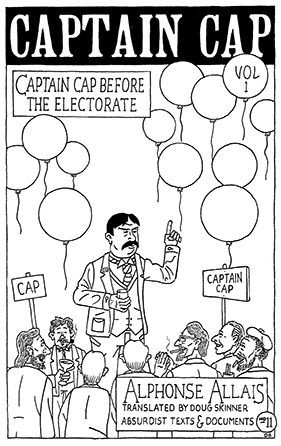
Black Scat proudly announces the publication of Captain Cap by Alphonse Allais—the first of three volumes in a series of “captails” translated from the French by grand maestro Doug Skinner—who also illustrated the edition and produced its sublime cover.

Vol. I (“Captain Cap Before the Electorate”) covers the captain’s notorious political career—including an unexpurgated appendix of his favorite cocktails**.

That this work by Allais has never before appeared in English makes this a literary event worthy of balloons, noise-makers, champagne, and an inebriated marching band.

CAPBUTTON

And to celebrate the Captain’s launch we’re christening this limited edition by offering a FREE Captain Cap campaign button to the first twelve connoisseurs who order a copy.

UPDATE (2/15): All the buttons are gone, alas.

Now if you’ve read this far and are wondering who Captain Cap was, here’s a brief excerpt from the translator’s introduction:

“Many discerning readers think Alphonse Allais was
the finest humorist France ever produced. I will have
to concur. Many go further, and class him simply as a
master of the short story. I will have to agree with that
as well. And many claim that his greatest creation was
that hard-drinking adventurer and inventor, Captain
Cap. I will go along with that too, but with one quibble:
Captain Cap really existed.

His real name was Albert Jean Baptiste Nicolas
Caperon, and he was born in Paris in 1864. His father,
Paulin Caperon, had inherited a fortune in his twenties,
and devoted himself to radical politics, bibliomania,
and banking, in no particular order. It was while
practicing the last that he sold railway shares in Alsace
to a Swiss bank; when Germany annexed Alsace in
1871 after the Franco-Prussian war, Germany confiscated
the stock. The Swiss bank wanted its money
back, leaving Caperon in an uncomfortable situation.
He resolved it by fleeing to Belgium, and then to
America, where he adopted the name of Peter Coutts,
and bought land in Mayfield, California (now Palo
Alto).”

We would be remiss did we not mention that the first title in our Absurdist Texts & Documents series was Masks by Alphonse Allais, for its author embodies the spirit which inspires this small press.

Captain Cap is limited to 125 copies, so we suggest you order quickly before it’s too late.

CLICK HERE AND CAST YOUR VOTE FOR CAPTAIN CAP

And have a drink on him!

___________________
**Be sure and try the recipe for Corpse Reviver (pg. 53)

Laughter & Cheer for the New Year!

A Cami Sampler

We proudly present a New Year’s treat—#9 in our Absurdist Texts & Documents series: A CAMI SAMPLER, translated from the French by John Crombie in Paris. The collection includes 10 zany, Dadaesque microdramas by Pierre Henri Cami, plus nine pages of his rare drawings. This is the first collection of Cami’s mini plays to be published in the U.S.

From the introduction by John Crombie:

“Though blissfully ignored for most of his life by the
English-speaking public, Cami (Pierre Henri) remained
for four full decades one of France’s most prolific,
and acclaimed, comic authors. Hailed by his idol and
admirer Charlie Chaplin as ‘the greatest humorist in the
world,’ Cami was somewhat willfully omitted by André
Breton from his Anthologie de l’Humour Noir—no doubt
on account of his huge popular success—but admired
by other Surrealists. Between 1910, when he founded
Le Petit Corbillard Illustré, the ‘humorous organ of the
corporation of undertakers,’ and his death in 1958,
Cami published well over forty volumes of minidramas
and comic novels—notably The Memoirs of God-the-
Father, The Adventures of Loufock-Holmes, The Son of
the Three Musketeers, and the travels of his perhaps most
famous creation, Monsieur Rikiki and the Rikiki family—
as well as countless songs, strip cartoons, screenplays
and even operettas. Many of these he also illustrated.

But Cami was best known for his ‘dramatic fantasies,’
written mostly for La Vie Drôle, the humorous column
published weekly by Le Journal, where he had stepped,
somewhat belatedly, into the shoes of that column’s
immortal co-founder, Alphonse Allais. Self-styled
microdramas of everyday life, of legend, of history
(and even of geography), of true (and false) romance,
and more often than not of volupté, these screwball
skits look backward to the music hall and Alfred Jarry,
sideways to the Marx Brothers and forward to, in
England, the Goons and, in France, to the Theatre
of the Absurd.”

Edition limited to 100 copies.

THIS BOOK IS OUT OF PRINT