IMAGINARY HOTHEADS

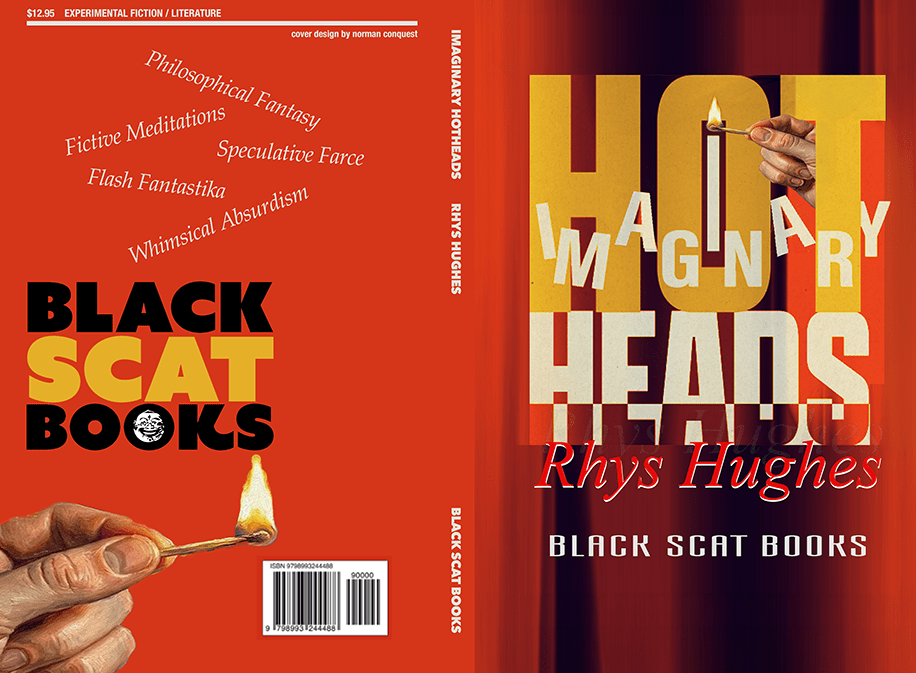
Welsh writer Rhys Hughes performs his magic in this masterful work of experimental fiction. Imaginary Hotheads is an intricately constructed fiction divided into three sections (“The Moving Finger.” “Hannah and her Cisterns,” and “The Fortnight Fistfight”). Each section is a frame around a selection of smaller fictions. These short “flash fantastika” are mystically linked — often connected by mood, theme or style.

Imaginary Hotheads exhibits the author’s signature absurdism, wordplay and whimsy, laced with hard-edged, speculative epiphanies.

IMAGINARY HOTHEADS
Rhys Hughes
Trade paperback, $12.95, 102 pp.
ISBN 979-8993244488


CRITICAL ACCLAIM FOR RHYS HUGHES

“If I said he was a Welsh writer who writes as though he has gone to school with the best writing from all over the world, I wonder if my compliment would just sound provincial. Hughes’ style, with all that means, is among the most beautiful I’ve encountered in several years.”— SAMUEL DELANY

“Rhys Hughes seems almost the sum of our planet’s literature. As well as being drunk on language and wild imagery, he is also sober on the essentials of thought. He has something of Mervyn Peake’s glorious invention, something of John Cowper Powys’s contemplative, almost disdainful existentialism, a sensuality, a relish, an addiction to the delicious. He’s as tricky as his own characters, he toys with convention, he makes the metaphysical political, the personal incredible and the comic hints at subtle pain. Few living fictioneers approach this chef’s sardonic confections, certainly not in English.” — MICHAEL MOORCOCK

“A dazzling disintegration of the reality principle. A rite of passage to the greater world beyond common sense. Raises the bar on profundity and sets a comic standard for the tragic limits of our human experience. Like Beckett on nitrous oxide. Like Kafka with a brighter sense of humour.” — A.A. ATTANASIO

“It’s a crime that Rhys Hughes is not as widely known as Italo Calvino and other writers of that stature. Brilliantly written and conceived, Hughes’ fiction has few parallels anywhere in the world. In some alternate universe with a better sense of justice, his work triumphantly parades across all bestseller lists.” — JEFF VANDERMEER

“Hughes’ similarity to Spike Milligan runs deeper than the occasional shared lurch of phrase, for he writes as though he’d been bloodied in the same wars Milligan fought for eight decades: the same up yours melancholia about the malice of the absurd – about the absurdness of the world defined not only as an inherent lack of species-friendly grammar in the convulsion of the real, but also a sense that anyone who acts as though he believes what he is told by our Masters will almost necessarily inflict pain on others.” — JOHN CLUTE

“What do I like about Rhys Hughes’s work? Fun. Hughes sees and precipitates in words the latent humour in almost anything. Ranging from what our culture considers pleasing and smilingly ridiculous to horrors that have to be laughed at if they are faceable at all, Hughes is a laughing observer, both inside and outside. With Hughes you get humour that is white, various shades of grey, black – and I don’t know why humour cannot be characterized by other colours. I am also enormously impressed by Hughes’s stylistic brilliance. The richness of language, the occasional Cambrianisms, the inexhaustible array of puns, weird metaphors that form the point of a story. And I envy him his netted imagination. As a man who sees connections where others do not, he offers enough ideas, if parcelled out, to fill a catalogue of fantasy for a generation of writers.” — E.F. BLEILER


Also Available from Black Scat:
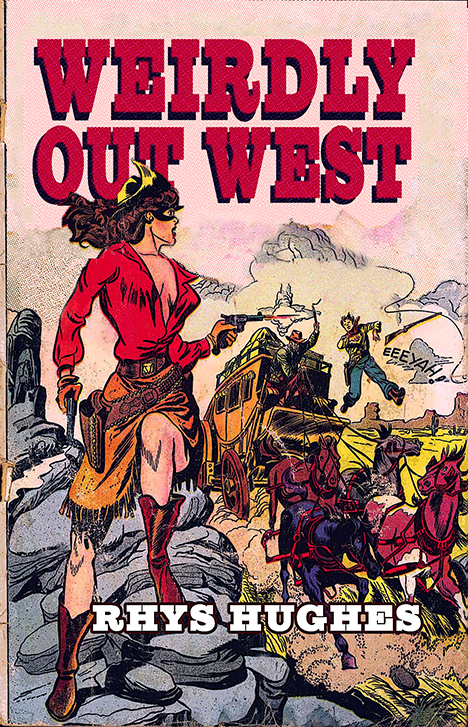
Rhys Hughes saddles up and blasts his way across the vast plains — kickin’ up trouble in this hog-wild collection of Western Weirdness. Using various forms (short stories a play, lonesome poems — even a garsh-dang essay!), he roasts the genre and serves up some hearty, avant-garde grub — fresh as a dew-dappled Texas rose.

Dive in for some “Blazing tales of cowpoke lit!”

HAPPY NEW YEAR!

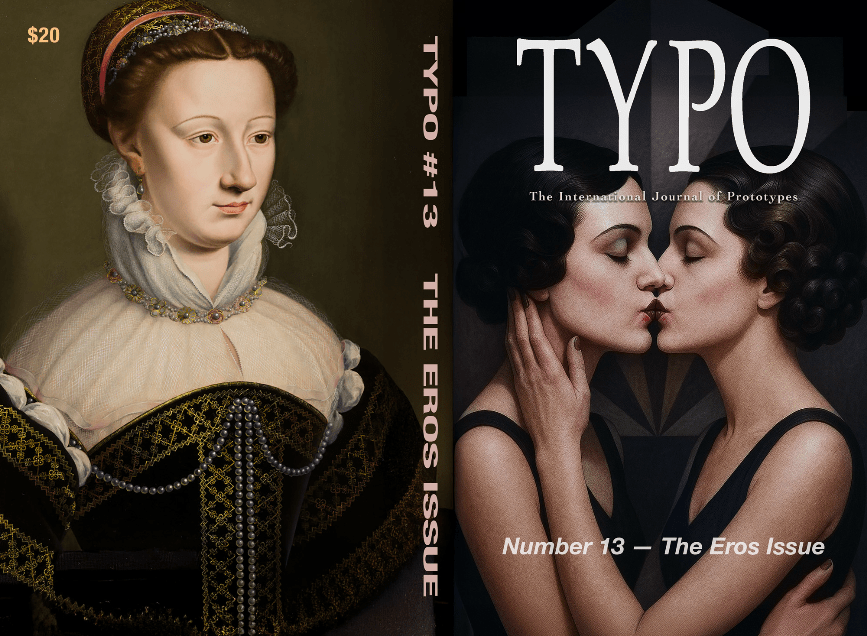
What a great way to start 2026 — “The Eros Issue” of TYPO: The International Journal of Prototypes #13 — 160 pages of prurient prose, poetry, & titillating graphics. Featuring Nile Southern‘s Oulipian dive into Daddy Terry Southern‘s classic novel CANDY; Amy Kurman on silent stag films; an interview with a bisexual Surrealist vampire; suggestive covers from a 1930s French glamour zine; a report on a shocking Parisienne incident by Alfred Jarry; excerpts from Walter Serner‘s novel THE TIGRESS; and much more.

This special issue includes stellar works by Madeleine de L’Aubépine; Marcel Béalu; Erik Belgum; Tristan Bernard; Terry Bradford; R J Dent; Mike Ferguson; Rachel Galvin; Massimo Gatta; Edward Gauvin; Alfred Jarry; Gabriel de Lautrec; George MacLennan; Alfred de Musset; Opal Louis Nations; Ernesto López Parra; Alejandro Albarrán Polanco; Bernard Quiriny; James Richie; George Sand; Doug Skinner; Lono Taggers; Corinne Taunay; Robin Tomens; Paul Willems, and Mark Wyatt.

Don’t miss TYPO 13.

THE LAND OF LOST SIMULACRA

Apollo Camembert is the brainchild of Eckhard Gerdes but signals a darker side to his writing than his earlier work published under his own name. Apollo Camembert’s protagonist Guy has to deal with the darkness that comes from the anti-intellectual cloud hovering over and obscuring the contemporary world. Along the way, the professor finds a couple of allies. Together they fight the status quo, but they have their own issues, too….

“Kafka meets Inspector Clouseau, and the two discover they have a lot in common. The word wizard that he is, in The Land of Lost Simulacra Eckhard Gerdes (writing as Apollo Camembert) shows us that language can be the subject of a novel as much as characters and events.”Yuriy Tarnawsky

“Reading Eckhard Gerdes writing as Apollo Camembert is like sitting in the lap of Samuel Beckett telling stories to Eugene Ionesco trapped inside a David Lynch world. The beauty of Gerdes’ writing is its subtle simplicity of sentence structure and narrative tone that transforms banal moments into deeper truths. And every decision the narrator makes only deepens his disorientation. He becomes a Kafkesque man who cannot ever remember where he has been. The novel follows the narrator on epic journeys flooded with existential crisis after existential crisis that any new adjunct hire in academia must traverse: finding a bathroom, finding the elusive, theoretical English Department, hoping to stumble upon or discover the classroom where he is to teach the youth, teaching in only the oddest of odd classrooms, finding new ways to say the same thing in new ways, desperately on a quest for coffee. The gentle absurdity of this work is delightful. The dialogue is sharp and biting. Brilliant humor throughout: brilliant in the true sense of the word: a light shining on life’s insanities.”
Doug Rice, author of Here Lies Memory


THE LAND OF LOST SIMULACRA
Apollo Camembert
Paperback; 252 pp., $16
979-8993244433

NEW ISSUE!

IN THIS ISSUE:
Julien Gracq’s “The House”
Albert Cossery’s “Perpetually Barking Man”
The Belgian School of the Bizarre
Paul Nougé’s Optic Unveiled
A “Surreal Wheels” pictorial
Doug Skinner’s intrusive Reader Survey
A rare Boggle toss
Bouncing Draculas
An Oulipian crossword puzzle

And more avant-garde goodness.

FEATURING 38 LUMINARIES: Robert Archambeau; Corina Bardoff; Terry Bradford; Igor Bulatovsky; Paul Busson; Apollo Camembert; Norman Conquest; Albert Cossery; Noël Devaulx; Rachel Galvin; Jean-Luc Gameau; Shawn Garrett; Edward Gauvin; Julien Gracq; Pierre Autin-Grenier; Daniel Y. Harris; Rick Henry; Esteban Isnardi; Julia Lillard; Joshua Martin; George MacLennan; Dmitri Manin; Paul Nougé; Thomas Owen; Angelo Pastormerlo; Alejandro Albarrán Polanco; Bernard Quiriny; Adam Ranđelović; Simon Read; Doug Skinner; Lono Taggers; Mark Valentine; Tim Walker; Gregory Wallace; Alyson Waters; Andrew Wenaus; Tom Whalen; Bill Wolak.

TYPO #12: The International Journal of Prototypes
edited by Norman Conquest & Paul Rosheim
Trade paperback; 157 pp., illustrated.
ISBN 979-8-9923826-9-3

Summer Reading…

Avant-garde composer & poet, Mirtha Pozzi in Paris.

Don’t miss the current issue of TYPO: The International Journal of Prototypes, featuring the first English translation of a novelette by surrealist André Pieyre de Mandiargues, and previously unavailable translations from a diverse selection of neglected literary masters: Marcel Schneider, Bernard Quiriny, Fritz von Herzmanovsky-Orlando, Walter Serner, and others. Plus art and startling surprises.

TYPO #9: A Fusion of Avant-Garde Literature

Like a robot assembled in a subterranean laboratory, this issue contains prototypical pieces from around the world. Many contributors were previously seen in so-called Obscure Publications. Others have been freshly translated from rare French, Belgian, and Russian books and magazines. Some authors are well-known in avant-garde or fantasy circles. Some artists & writers are just breaking through. But all have been brought together to create this sublime issue for your pleasure.

FEATURING: Alphonse Allais; Chiara Ambrosio; Robert Archambeau; Pierre Bettencourt;  Greg Boyd; Terry Bradford; H.V. Chao; Norman Conquest; Lynn Crawford; Caroline Crépiat; R J Dent; Mark Ducharme;  Jean-Luc Garneau; Edward Gauvin; Vasilisk Gnedov; Kirpal Gordon; Michael Gould; André Hardellet; Jordan Jones; Amy Kurman;  Joel Lipman; Emilia Loseva; Stephen-Paul Martin; George MacLennan; Henri Michaux; Claudio Parentela;  Angelo Pastormerlo; Gabriel & Marcel Piqueray; Bernard Quiriny; Doug Skinner; Renée Vivien; Danny Winkler; Bill Wolak.

TYPO #9: The International Journal of Prototypes
152 pp., trade paperback; $20
ISBN 979-8-9923826-0-0

Funny Farm …

What happens when constellations socialize, when Faust and the Devil start drinking, when imaginary friends gain imaginary friends, when Sleeping Beauty and Rip van Winkle trade places, when Duncan paints a cockatrice, when a terrifying Werechurch roams the land? And was it really a good idea for August and Collier to start that potato farm, especially given Collier’s troubled past? Doug Skinner defines his own comic genre, filled with vivid characters, fictional physics, and surprising narratives, often filtered through stringent constraints to keep the language lively. If you read only one book this year, read this one over and over again!

AN ERROR-FILLED TREASURE TROVE!

The long-awaited “errata” issue is now available.

FEATURING WORKS BY: Terri Carrion, Norman Conquest, Caroline Crépiat, Farewell Debut, S. C. Delaney, Jean-Pierre Duffour, Errorbiblioteca, Paul Forristal, Ryan Forsythe, Eckhard Gerdes, Rhys Hughes, Amy Kurman, Alex McKeown, Claudio Parentela, Angelo Pastormerlo, Agnès Potier, Collin J. Rae, C. R. Resetarits, Jason E. Rolfe, Paul Rosheim, Doug Skinner, Kristine Snodgrass, Linda Klieger Stillman, Corinne Taunay, Michel Vachey, Carla M. Wilson.

BRING ME THE HEAD OF FRANZ JOSEPH HAYDN!

Jason E. Rolfe‘s mesmerizing new chapbook, THE PUPPET-PLAY OF DOCTOR GALL, is a shadowy existential drama — an absurdist murder-mystery set in Vienna in 1820, with a cast of curious characters: Franz Joseph Gall, The Stranger, Ernst Sieber, Tomas Hocheder, Madam Denebecq, and Count Sedlnitzky.

Are they mere puppets whose every move is directed from above by Madam Denebecq, a self-titled mechanikus? Or are they all too human, performing their lives before our very eyes? And who, in the name of heaven, has stolen the head of Franz Joseph Haydn?

We had intended to reveal the answers to these questions but, alas, it’s too late. The lights have dimmed and the audience is holding its collective breath (if breathe they do).

Order your copy before the curtain rises.

No strings attached.