You’re #1 on Amazon.

See what all the screaming’s about.

You’re #1 on Amazon.
See what all the screaming’s about.

Alfred Jarry spent his brief and turbulent life experimenting with genres of fiction. In his last few years, he created a new fictional form: the absurdist speculative essay. R J Dent’s new English translation of Speculations contains 68 of Jarry’s essays, originally printed between 1901 and 1904 as a series, ‘Spéculations’, in the French journal Le Revue Blanche.
In Jarry’s darkly comic collection of surrealist and satirical prose pieces, the renowned author deploys his characteristic satirical eye and dark humor to devastating effect. These essays range in tone from the wildly comic to the deeply tragic and cover a diversity of subjects, ranging from French Trees to Cannibalism. For Jarry, nothing is sacred; everything is worthy material for his surreal satire; the Passion is presented as a sporting event; buses are the prey of big game hunters, and even the Queen is licked from behind.
A series of sly investigations into fin de siècle France that reads like a beautiful & bloody
handful of paper cuts, splintered essays that turn authority on its head in sharp bursts of
wicked logic, R J Dent elegantly capturing Jarry’s iconoclastic spirit, his scandalous heart.
—Matthew Kinlin
There’s a story that Jarry carried a loaded revolver around with him (said revolver Picasso obtained after his death, and took it with him on night walks around Paris). A woman living near Jarry complained to him about the danger of his gun-toting to her children. To which Jarry said, “If that should ever happen, ma-da-me, we should ourselves be happy to get new ones with you.” If you can appreciate as demented a sentiment as that, you can have a hundred more reading Speculations, in a delightful translation from R. J. Dent. —Conor Hultman, The Local Voice

Edible contents:
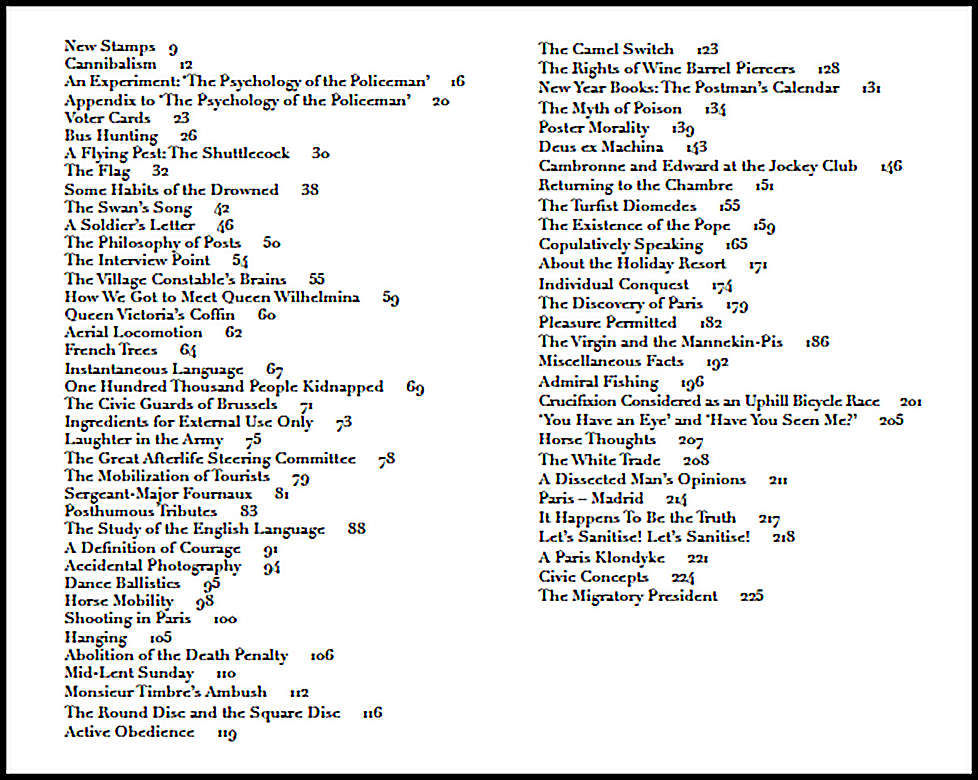
SPECULATIONS
Alfred Jarry
Translated by R J Dent
Paper; 5.06 x 7.81 inches; 235 pp., $15.95
ISBN 13 979-8-9859996-1-7

We proudly present a New Year’s treat—#9 in our Absurdist Texts & Documents series: A CAMI SAMPLER, translated from the French by John Crombie in Paris. The collection includes 10 zany, Dadaesque microdramas by Pierre Henri Cami, plus nine pages of his rare drawings. This is the first collection of Cami’s mini plays to be published in the U.S.
“Though blissfully ignored for most of his life by the
English-speaking public, Cami (Pierre Henri) remained
for four full decades one of France’s most prolific,
and acclaimed, comic authors. Hailed by his idol and
admirer Charlie Chaplin as ‘the greatest humorist in the
world,’ Cami was somewhat willfully omitted by André
Breton from his Anthologie de l’Humour Noir—no doubt
on account of his huge popular success—but admired
by other Surrealists. Between 1910, when he founded
Le Petit Corbillard Illustré, the ‘humorous organ of the
corporation of undertakers,’ and his death in 1958,
Cami published well over forty volumes of minidramas
and comic novels—notably The Memoirs of God-the-
Father, The Adventures of Loufock-Holmes, The Son of
the Three Musketeers, and the travels of his perhaps most
famous creation, Monsieur Rikiki and the Rikiki family—
as well as countless songs, strip cartoons, screenplays
and even operettas. Many of these he also illustrated.
But Cami was best known for his ‘dramatic fantasies,’
written mostly for La Vie Drôle, the humorous column
published weekly by Le Journal, where he had stepped,
somewhat belatedly, into the shoes of that column’s
immortal co-founder, Alphonse Allais. Self-styled
microdramas of everyday life, of legend, of history
(and even of geography), of true (and false) romance,
and more often than not of volupté, these screwball
skits look backward to the music hall and Alfred Jarry,
sideways to the Marx Brothers and forward to, in
England, the Goons and, in France, to the Theatre
of the Absurd.”
Edition limited to 100 copies.
THIS BOOK IS OUT OF PRINT
 blackscatbooks.com