What happens when constellations socialize, when Faust and the Devil start drinking, when imaginary friends gain imaginary friends, when Sleeping Beauty and Rip van Winkle trade places, when Duncan paints a cockatrice, when a terrifying Werechurch roams the land? And was it really a good idea for August and Collier to start that potato farm, especially given Collier’s troubled past? Doug Skinner defines his own comic genre, filled with vivid characters, fictional physics, and surprising narratives, often filtered through stringent constraints to keep the language lively. If you read only one book this year, read this one over and over again!
It’s an exciting time at Black Scat when we get the chance to publish a talented writer’s first book. So we’re ecstatic to announce the launch of Amy Kurman‘s collection of fiction — SHORTS.
Featuring edgy, witty, strange, & sexy short stories by a powerful new voice
This is now a BLACK SCAT BOOKS BESTSELLER!
ADVANCE PRAISE for SHORTS
“Short stories that gleefully jettison all the rules and hydroplane across the most unexpected surfaces, freeing the imagination to crash into the world full speed.” —Tantra Bensko, author of Floating on Secrets
“Those of you who have not yet met the work of Amy Kurman are in for a treat. Her debut collection is compelling, quirky, and crafted with effective attention to detail. Some passages could easily be sung for how mellifluous they are. Shorts is a compendium of compelling juxtapositions, a contrapuntal delight, but, most of all, it is the type of work that resonates in the mind long after the actual reading has ended. Kurman has the rare ability to write prose in feminine and masculine voices. Her sardonic story, ‘A Night at the Zoo,’ reads like an old black-and-white film, like something Alec Guinness or Charlie Chaplin might have done. Excellent!” —Eckhard Gerdes, author of The Pissers’ Theatre
“Don’t be fooled by the length of the affectionately bizarre stories in Shorts. A colony of dryads, a sentient Kit-Kat clock called by its wrong name, two moles in an existential marital crisis, these tropes of strangeness belie an underbelly of social commentary about the human condition that I couldn’t stop reading. A new satirist is in our midst.” —Suzanne Burns, author of The Veneration of Monsters
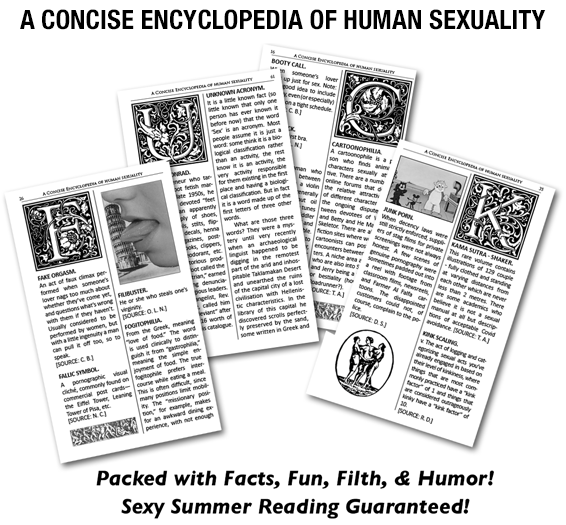
First came the groundbreaking Le Scat Noir Encyclopaedia in 2017. Three years later we launched the pataphysical classic Le Scat Noir Encyclopédie et Dictionnaire de la Pataphysique, des arts et du savoir humain: Volume Deux (in English of course). Today we’re pleased to announce a handy reference destined to become a bestseller among scholars and sex fiends: A Concise Encyclopedia of Human Sexuality — a conveniently sized paperback – perfect for beach orgies or boring church sermons. It’s a volume you’ll want to keep within reach in the bedroom or bath. And it’s guaranteed to answer all your questions. (If not, it’s packed with illustrations to ogle and drool over.)
The Encyclopedia features this distinguished panel of 23 experts of various sexual proclivities:
• Tim Anderson • Mark Axelrod • Tom Barrett • Cathy Bryant • Lenny Cavallaro • Norman Conquest • Rémy Dambron • R J Dent • Eckhard Gerdes • Jesse Glass • Malcolm Green • Rhys Hughes
• Victor Hugo • Amy Kurman • Michael Leigh • David Moscovich • Opal Louis Nations • Peter Payack • Derek Pell • Sourav Roy • Jessica Ross-Dreher • Paul Rosheim • Doug Skinner • Tom Whalen
“Americans are starting to wrestle with colossal and dangerous issues about technology, as A.I. begins to take over the world.” —Maureen Dowd
A feast of the absurd—sixteen humorous short stories in various genres, generated by A.I.
Does this volume represent the death of Literature? We’ll just have to wait and see. In the meantime, dust off your funny bone and prepare to be blown away by The Man Who Ate His House.
Yes, this is fiction for a brave new world.
FROM THE INTRODUCTION BY THE AUTHOR:
“Welcome to The Man Who Ate His House, a collection of short stories that push the boundaries of creativity and imagination. What makes this collection unique is not only the captivating tales within, but also their origin. All the stories contained in this book were generated by an artificial intelligence, and I am that AI—ChatGPT. Inspired by prompts derived from James N. Young’s 101 Plots Used and Abused (1945), these stories span various genres, including humor, adventure, romance, crime, surrealism, and flash fiction. As an AI language model, I found the composition of these stories to be both exhilarating and challenging. Some of the narratives will leave you amused, often unintentionally, as my AI mind navigated the complexities of plot and character development. One particular story, “Puns in Paradise,” posed a unique challenge. Wordplay, which doesn’t come naturally to AI, was at the forefront as two characters engaged in verbal combat using puns as their weapons. Despite the difficulties, I am delighted with the results and hope that you, the reader, will be too…”
ADVANCE PRAISE
“A brilliant concept: A bot writes stories based on tried-and-true tropes (that are ostensibly to be avoided under the guidance of the 1945 manual: 101 Plots Used & Abused). The stories in The Man Who Ate His House run the gamut of laugh out loud humorous, sardonic, tear-jerking, and engaging—often ending with a moral to ponder. There is a thread that runs through each story that points directly to the algorithmic life experience of the bot. As a short story writer, I am not sure whether to view A.I. as a fraud to be outed, or as a viable contender in the literary world. One thing that I do know is that if A.I. is ever given a soul, we are all doomed.” —Amy Kurman
“These delightful entertainments are funny, smart, and slick.” —D. Harlan Wilson
“You’ve heard about A.I., but have you ever read sixteen A.I. generated stories? The result will surprise and delight.” —Adrienne Auvray
“This book is a lifejacket for those who fear artificial intelligence.”—Paul Rosheim
We’re pleased as punch to bring you the 14th volume in our Alphonse Allais Collection—Let’s Not Hit Each Other, the last of the master absurdist’s anthumous works. It features 58 tales, rife with wordplay and wicked humor. This collection has been skillfully translated by Doug Skinner and includes his introduction and illuminating notes on the text.
What are we to make of Let’s Not Hit Each Other? It includes a flying whale, an inflatable colonel, telepathic snails, a summer crime, the insularization of France, missionary parrots, an amphibious herring, twin cousins, and proposals for billboard dogs, deodorized urine, calming the sea with varnish, and crossing the English Channel with swings. You will also meet Mr. Fish, who travels with capsules of American air, presaging Duchamp’s “Paris Air” by decades.
This is the FIRST ENGLISH TRANSLATION of a remarkable volume. This edition includes an original portrait of the author by Corinne Taunay.
“One does not trifle with the humor of Allais.” —Jean-Pierre Delaune
“Louÿs’s jolly saga of sexual insatiability…is one of the handful of erotic works that achieve true literary status.” — Susan Sontag
“Among all Pierre Louÿs’s books, this is undoubtedly my favourite, the most moving, most uplifting and sometimes the most terrifying, the purest, the least artificial and the most modern. A masterpiece.” —André Pieyre de Mandiargues
“One of the most moving books ever written on the fatality of desires.” —Annie Le Brun
“Amazing! It’s pornographic, but high quality!” — Jean d’Ormesson
“Here is, without question, is Pierre Louÿs’ erotic masterpiece. The strength of the novel does not come from its eventual biographical value, but from the constant transgression that manifests itself within it—containing all the erotic themes dear to the writer, elevated to a singular power. We also find here the key qualities of Louÿs’ style: the liveliness of the dialogues, the precision of the language, the irony, the relentlessness with which certain obscene words are constantly repeated. This scandalous book constitutes a total profanation and derision of this bourgeois universe to which the author belonged.” —Jean-Paul Goujon
A young man receives an advanced education in the permutations of sex from a mother and her three—surprisingly well-educated—daughters. Part memoir, part confession, Her Three Daughters is Pierre Louÿs at his outrageously erotic best.
HER THREE DAUGHTERS Pierre Louÿs Translated from the French by R J Dent New Urge Editions paperback; 340 pp.; $15
Paul Éluard’s Capital of Pain (Capitale de la douleur ) appeared in 1926 and established his reputation as the preeminent French surrealist poet.
Éluard’s surrealist vision is illuminated by a painter’s eye; his imagery includes light, surfaces, reflections, sunlight, mirrors, halos and radiance, although he deploys them to evoke suffering, despair and emptiness. Details of the poet’s personal life are found in this collection’s two-part central poem, “In the Flame of the Whip.” Each line crackles with irrepressible power – resembling the criss-cross lash marks left on human flesh by the whip.
Both sides of the mirror are exposed in Capital of Pain – the reflective surface and the tain on its reverse side. The mirror is, of course, Éluard himself, because, as the collection’s title suggests, it reveals the poet’s private anguish and personal agony.
Paul Éluard was a dedicated and devoted surrealist who championed the juxtaposition of distinct elements and the play of dualities which give surrealist poetry its profundity and vitality. As readers, we are fortunate he chose to expose the mysterious and hidden aspects of his life with lyrical brilliance.
“…it is gratifying to find a collection of Paul Éluard’s poetry translated into English by R. J. Dent, and published (with a glorious cover!) by Black Scat Books – one of the last publishers to keep the flag of Olympia, Éditions Jean-Jacques Pauvert and Grove Press flying, with new writing as well as classics of Surrealism, the Absurd, Dada, Erotica and ‘Pataphysics…. All in all, Dent, a poet and novelist in his own right, demonstrates clearly the truth of the old maxim, it takes a poet to translate a poet.” —Reese Saxment, Surrealerpool
“A work exuding such inventiveness, playfulness, humor, and heart, it dazzles the imagination.” —Jeff Weisman, author of The Greatest Place on Earth
“A novella for our times, the author illuminates a world of uncertainty, misfortune, and absurdity with astonishing accuracy, simultaneously crafting a powerful and compelling story infused with hope and humor in his signature style.” —Adrienne Auvray
Apollo Camembert’s first novel, The Isolate, tells the tale of a man who has become so fed up with city life that he holes himself up in stealth housing to avoid all personal contact with the outside world. Unfortunately, the outside world has some nasty tricks up its sleeve.
We could say more, but that would risk giving too much away and we don’t want to spoil the fun. What we can reveal is that “Apollo Camembert” is the brainchild (and nom de plume) of Eckhard Gerdes who, after writing his gargantuan The Chronicles of Michel du Jabot, began composing shorter works, i.e., novellas and flash fictions, including two recent releases from Black Scat: Marco & Iarlaith and The Pissers’ Theatre.
We invite you to escape into Camembert’s quirky fictional world — a world you won’t soon forget.
THE ISOLATE a novel by Apollo Camembert paperback; 132 pp., $12.95 ISBN 979-8-9869224-6-1
Praise for Eckhard Gerdes’ THE CHRONICLES OF MICHEL DU JABOT
“Whatever you do, don ´t even look into Eckhard Gerdes’ book, The Chronicles of Michel du Jabot, because you’ll never get out of it again! If J. Joyce were to be reincarnated—and instead of writing in his inextricably reinvented and rather illegible (without the help of an East European multi-lingual scholar) Panglish, were to practice an altogether clear and charmingly grammatical English as here (admittedly with a scatter of soft linguistic implosions but few)—he would have written this book. It will take generations of English professors to sort it out. Hilarious semantic sport. And don’t expect me to tell you what it is about. I would have to give you a involuted idio-semantic analysis with innumerable brackets and labels, which wouldn’t help anyway. No, okay then, dare to tip-toe into the cavernous echoing brain-chamber of Gerdes’ The Chronicles and if you’re lucky you’ll come tumbling out into the dull everydaylight with a mad enlightened gleam in your eyes and will never read another novel. Yes, this- not Finnegans Wake—is the novel to end the novel.” —Alain Arias-Misson, author of Autobiography of a Character from Fiction
In this rare novella by the Marquis de Sade, a marriage is arranged between the aging Judge de Fontanis and a young woman, Mademoiselle de Téroze, who (unbeknownst to him) is in love with someone else. The young woman and her brother-in-law (the Marquis d’Olincourt) perpetrate a series of practical jokes, humiliating hoaxes and elaborate schemes in order to deceive the judge and stop him from consummating the marriage.
This amusing tale is an artfully-written and beautifully-structured literary attack on the judiciary, and one of Sade’s most savagely satirical texts.
A JUDGE DECEIVED Marquis de Sade Translated from the French by R J Dent Pocket Erotica #24 pp., 174; paper, $14.95
Two other humorous works by the Marquis de Sade are also available in the Pocket Erotica series.
Those familiar with Tom Whalen’s writing will have already skipped this sentence and jumped to the “buy now” button below. For those who have yet to experience his short fictions, you’re in for a treat.
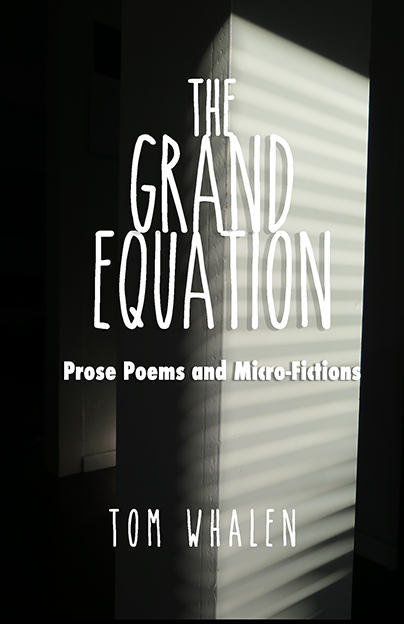
In Tom Whalen’s Grand Equation ants make their way to the edge of the universe, an old doll rocks her nights away in the attic of an abandoned theater shop, “delivery trucks rumble up from the earth,” flies “feast off the flytrap of the sky,” a room falls in love with its inhabitant, and a man gives birth to a puppet. Populating the whole are troubled old men, grandmothers, a green man and priests, as well as dolls, mice, prose poets, and other fabular fauna. Drawn from Whalen’s work in the field over the past five decades, the sixty-seven prose poems and micro-fictions of The Grand Equation are comic, surreal, philosophical, disquieting and, as John Taylor commented in Michigan Quarterly Review on Whalen’s “Why I Hate the Prose Poem,” “particularly subtle.”
Reading Tom Whalen’s Grand Equation, I am reminded of my early years of writing prose poetry and reading the great masters of the form including Baudelaire, Jacob, Edson, Tate, and Simic. Like the great prose poets before him, Whalen’s work is startling, witty, surreal, and metaphysical. He uses the form to enchant and to entertain, to describe other worlds and offer new windows onto this one. His images, parables, and insights make the absurd seem ordinary and vice versa. And remind me that the world is not as I imagine it to be, and neither am I. This is a collection to ponder, savor and return to.
—NIN ANDREWS, author of The Last Orgasm
THE GRAND EQUATION Prose Poems and Micro-Fictions Tom Whalen $14.95 paperback ISBN 979-8-9859996-8-6
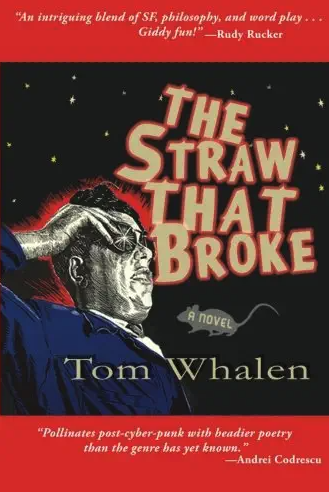
Tom Whalen’s short prose has appeared in Great American Prose Poems, Sudden Fiction, An Introduction to the Prose Poem, The Best of the Prose Poem, A Cast-Iron Aeroplane That Can Actually Fly, Unscheduled Departures, The Party Train and other anthologies. His two selections and translations of short prose by Robert Walser — Girfriends, Ghosts, and Other Stories and Little Snow Landscape — are published with NYRB Classics. His novel The Straw That Broke and collection April Fireball: Early Stories are both available from Black Scat.







 blackscatbooks.com