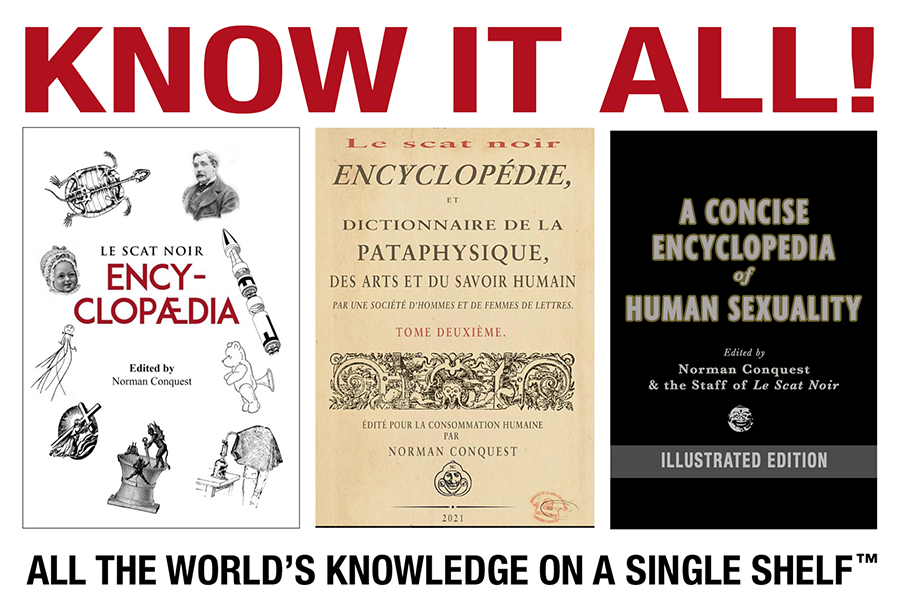
The only encyclopedias you’ll ever need—the Triad of Truth & Human Knowledge—only from Black Scat Books. Why spend hundreds of dollars and fill your library shelves when three inexpensive, illustrated paperbacks are all you need. No fuss, no mess. Get smart and you can know it all for less than a tank of gas.
Click on the titles below and order today before the world burns to a crisp.
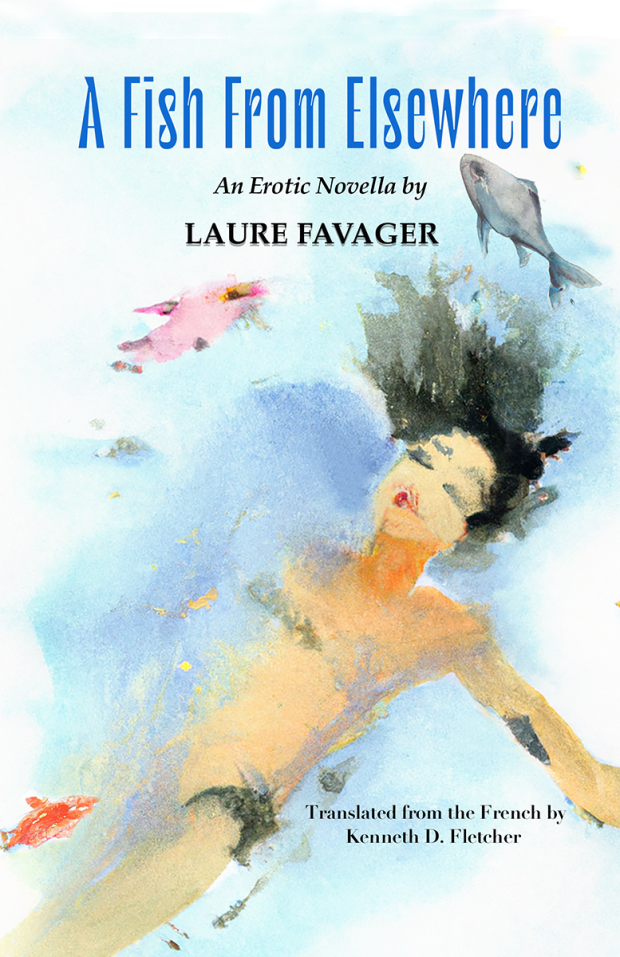
Eléa follows a strange fish and is thrown into a provocative realm of unabashed sexual gratification. Faced with evading the grip of the law, escaping the intoxicating clutches of l’hôpital du plaisir, and eluding the ire of her parallel lover’s fiancée, she must return home before she fades away altogether.
A startling, surreal, satiric erotic escapade, this raunchy Wonderland is imbued with the spirit of Kafka, Nin, and Terry Southern.
Laure. Favager’s style is engaging and disruptive, transporting readers into a surreal world where the lines between reality and sexual fantasy blur. The author’s vivid and explicit prose create a comic atmosphere that is both sexy and unsettling, immersing the reader in Eléa’s increasingly erotic escapades.
ABOUT THE AUTHOR
Laure Favager’s short fiction has appeared in several literary journals in France and Quebec. This is her first publication in the U.S.
She lives in Brittany with two uninhibited cats.
UPDATE: Laure Favager’s The Desire Box is now available from New Urge.
“Americans are starting to wrestle with colossal and dangerous issues about technology, as A.I. begins to take over the world.” —Maureen Dowd
A feast of the absurd—sixteen humorous short stories in various genres, generated by A.I.
Does this volume represent the death of Literature? We’ll just have to wait and see. In the meantime, dust off your funny bone and prepare to be blown away by The Man Who Ate His House.
Yes, this is fiction for a brave new world.
FROM THE INTRODUCTION BY THE AUTHOR:
“Welcome to The Man Who Ate His House, a collection of short stories that push the boundaries of creativity and imagination. What makes this collection unique is not only the captivating tales within, but also their origin. All the stories contained in this book were generated by an artificial intelligence, and I am that AI—ChatGPT. Inspired by prompts derived from James N. Young’s 101 Plots Used and Abused (1945), these stories span various genres, including humor, adventure, romance, crime, surrealism, and flash fiction. As an AI language model, I found the composition of these stories to be both exhilarating and challenging. Some of the narratives will leave you amused, often unintentionally, as my AI mind navigated the complexities of plot and character development. One particular story, “Puns in Paradise,” posed a unique challenge. Wordplay, which doesn’t come naturally to AI, was at the forefront as two characters engaged in verbal combat using puns as their weapons. Despite the difficulties, I am delighted with the results and hope that you, the reader, will be too…”
ADVANCE PRAISE
“A brilliant concept: A bot writes stories based on tried-and-true tropes (that are ostensibly to be avoided under the guidance of the 1945 manual: 101 Plots Used & Abused). The stories in The Man Who Ate His House run the gamut of laugh out loud humorous, sardonic, tear-jerking, and engaging—often ending with a moral to ponder. There is a thread that runs through each story that points directly to the algorithmic life experience of the bot. As a short story writer, I am not sure whether to view A.I. as a fraud to be outed, or as a viable contender in the literary world. One thing that I do know is that if A.I. is ever given a soul, we are all doomed.” —Amy Kurman
“These delightful entertainments are funny, smart, and slick.” —D. Harlan Wilson
“You’ve heard about A.I., but have you ever read sixteen A.I. generated stories? The result will surprise and delight.” —Adrienne Auvray
“This book is a lifejacket for those who fear artificial intelligence.”—Paul Rosheim
T Y P O: Journal of Lettrism, Surrealist Semantics, & Constrained Design
Our second issue is packed with treats from around the world…
Alien alphabets
Prismatic subdivisions
Principles of double-talk
Post-Neoist portraits
Desiring specimens
Asemic architecture
Paul Éluard poetry
Titular typography
Surrealist trivia
Italian eye candy
Curlicues in review
Generic Sheet Music
Jarry on the English language
Historical filler text translations
& much more
Pierre Albert-Birot; Guillaume Apollinaire; Mark Axelrod-Sokolov; Tom Barrett; Allan Bealy; Miggs Burroughs; Jahan Cader; Janina Ciezadlo; Norman Conquest; Farewell Debut; R J Dent; Karen Eliot; Paul Éluard; Paul Forristal; Ryan Forsythe; Jesse Glass; Rick Henry; Rhys Hughes; Rory Hughes; Alfred Jarry; Richard Koman; Márton Koppány; Amy Kurman; Peter F. Murphy; Pata-No UN LTD; Gaston de Pawlowski; Derek Pell; Harry Polkinhorn; Tom Prime; Jason E. Rolfe; Ded Rysel; Doug Skinner; Giovanni Antonio Tagliente; Félix Vallotton; Andrew C. Wenaus; Adolphe Willette; Carla Wilson;William Wordsworth.
Trade paperback; 152 pp., $14.95 ISBN 979-8-9869224-5-4
We’re pleased as punch to bring you the 14th volume in our Alphonse Allais Collection—Let’s Not Hit Each Other, the last of the master absurdist’s anthumous works. It features 58 tales, rife with wordplay and wicked humor. This collection has been skillfully translated by Doug Skinner and includes his introduction and illuminating notes on the text.
What are we to make of Let’s Not Hit Each Other? It includes a flying whale, an inflatable colonel, telepathic snails, a summer crime, the insularization of France, missionary parrots, an amphibious herring, twin cousins, and proposals for billboard dogs, deodorized urine, calming the sea with varnish, and crossing the English Channel with swings. You will also meet Mr. Fish, who travels with capsules of American air, presaging Duchamp’s “Paris Air” by decades.
This is the FIRST ENGLISH TRANSLATION of a remarkable volume. This edition includes an original portrait of the author by Corinne Taunay.
“One does not trifle with the humor of Allais.” —Jean-Pierre Delaune
We don’t like to play favorites and with a list of some 200 titles we can’t. But we thought you might like to know which titles have been the most popular. So here is a list of our Top Ten. All are in print, so if you missed one just click on its cover.
10 Oulipo Pornobongo (2016)
9 Le Scat Noir Encyclopedie et Dictionaire (2020)
8 Captain Cap, Alphonse Allais (2013)
7 Le Scat Noir Encyclopedia (2017)
6 Critics & My Talking Dog, Stefan Themerson (2019)
“A work exuding such inventiveness, playfulness, humor, and heart, it dazzles the imagination.” —Jeff Weisman, author of The Greatest Place on Earth
“A novella for our times, the author illuminates a world of uncertainty, misfortune, and absurdity with astonishing accuracy, simultaneously crafting a powerful and compelling story infused with hope and humor in his signature style.” —Adrienne Auvray
Apollo Camembert’s first novel, The Isolate, tells the tale of a man who has become so fed up with city life that he holes himself up in stealth housing to avoid all personal contact with the outside world. Unfortunately, the outside world has some nasty tricks up its sleeve.
We could say more, but that would risk giving too much away and we don’t want to spoil the fun. What we can reveal is that “Apollo Camembert” is the brainchild (and nom de plume) of Eckhard Gerdes who, after writing his gargantuan The Chronicles of Michel du Jabot, began composing shorter works, i.e., novellas and flash fictions, including two recent releases from Black Scat: Marco & Iarlaith and The Pissers’ Theatre.
We invite you to escape into Camembert’s quirky fictional world — a world you won’t soon forget.
THE ISOLATE a novel by Apollo Camembert paperback; 132 pp., $12.95 ISBN 979-8-9869224-6-1
Praise for Eckhard Gerdes’ THE CHRONICLES OF MICHEL DU JABOT
“Whatever you do, don ´t even look into Eckhard Gerdes’ book, The Chronicles of Michel du Jabot, because you’ll never get out of it again! If J. Joyce were to be reincarnated—and instead of writing in his inextricably reinvented and rather illegible (without the help of an East European multi-lingual scholar) Panglish, were to practice an altogether clear and charmingly grammatical English as here (admittedly with a scatter of soft linguistic implosions but few)—he would have written this book. It will take generations of English professors to sort it out. Hilarious semantic sport. And don’t expect me to tell you what it is about. I would have to give you a involuted idio-semantic analysis with innumerable brackets and labels, which wouldn’t help anyway. No, okay then, dare to tip-toe into the cavernous echoing brain-chamber of Gerdes’ The Chronicles and if you’re lucky you’ll come tumbling out into the dull everydaylight with a mad enlightened gleam in your eyes and will never read another novel. Yes, this- not Finnegans Wake—is the novel to end the novel.” —Alain Arias-Misson, author of Autobiography of a Character from Fiction
In this rare novella by the Marquis de Sade, a marriage is arranged between the aging Judge de Fontanis and a young woman, Mademoiselle de Téroze, who (unbeknownst to him) is in love with someone else. The young woman and her brother-in-law (the Marquis d’Olincourt) perpetrate a series of practical jokes, humiliating hoaxes and elaborate schemes in order to deceive the judge and stop him from consummating the marriage.
This amusing tale is an artfully-written and beautifully-structured literary attack on the judiciary, and one of Sade’s most savagely satirical texts.
A JUDGE DECEIVED Marquis de Sade Translated from the French by R J Dent Pocket Erotica #24 pp., 174; paper, $14.95
Two other humorous works by the Marquis de Sade are also available in the Pocket Erotica series.








 blackscatbooks.com