Southern Discomfort…

cover12a

A yummy treat (for those with strong stomachs) is coming soon in our Absurdist Texts & Documents series…a new collection of strange  “tastes” from the late master chef Terry Southern:

HOT HEART OF BOAR & Other Tastes

We’ll be serving it fresh—piping hot and throbbing—in a limited edition of only 125 copies. First come, first served.

The book features rare unpublished texts, including an excerpt from The Hunters of Karinhalla screenplay that, sadly, was never filmed. It’s a bloody masterpiece, and we do mean bloody. There’s also a private letter to William Burroughs; a vomiting priest; “K.Y. Madness,” and more.

In addition to the author’s culinary delights, you’ll find illuminating introductory notes by Nile Southern, as well as tastefully explicit illustrations by Norman Conquest.

In short, it’s a full-boar feast for famished fans of black humor.

Prepare to dig in.

It’s Nostalgia Friday!

Here’s Black Scat author & translator Doug Skinner performing a ukulele solo: The Regard of Flight 23 — Second Homesickness Song. This clip was broadcast on TV in 1983 and is from a comedy play on tour starring Skinner, Bill Irwin, and Michael O’Connor.

A sweet treat to launch the weekend. Enjoy!

A man of many talents, Doug Skinner has translated Isidore Isou’s Considerations on the Death and Burial of Tristan Tzara and Captain Cap (Vol. I.) by Alphonse Allais—both in our Absurdist Texts & Documents series. In addition, he has written numerous scores for theater and dance, particularly for actor/clown Bill Irwin. His articles, cartoons, and translations have appeared in The Fortean Times, Fate, The Anomalist, Nickelodeon, Weirdo, and Black Scat Review. His translation of Giovanni Battista Nazari’s alchemical dream vision, Three Dreams, was published by Magnum Opus Hermetic Sourceworks in 2002.

You can follow him on his blog here.

Hip! Hip! Allais! Alphonse! Hooray!

Captain Cap

[TRUMPETS BLARING; BANNERS WAVING;  BABIES SHRIEKING; READERS CHEERING; etc.]

Black Scat proudly announces the publication of Captain Cap by Alphonse Allais—the first of three volumes in a series of “captails” translated from the French by grand maestro Doug Skinner—who also illustrated the edition and produced its sublime cover.

Vol. I (“Captain Cap Before the Electorate”) covers the captain’s notorious political career—including an unexpurgated appendix of his favorite cocktails**.

That this work by Allais has never before appeared in English makes this a literary event worthy of balloons, noise-makers, champagne, and an inebriated marching band.

CAPBUTTON

And to celebrate the Captain’s launch we’re christening this limited edition by offering a FREE Captain Cap campaign button to the first twelve connoisseurs who order a copy.

UPDATE (2/15): All the buttons are gone, alas.

Now if you’ve read this far and are wondering who Captain Cap was, here’s a brief excerpt from the translator’s introduction:

“Many discerning readers think Alphonse Allais was
the finest humorist France ever produced. I will have
to concur. Many go further, and class him simply as a
master of the short story. I will have to agree with that
as well. And many claim that his greatest creation was
that hard-drinking adventurer and inventor, Captain
Cap. I will go along with that too, but with one quibble:
Captain Cap really existed.

His real name was Albert Jean Baptiste Nicolas
Caperon, and he was born in Paris in 1864. His father,
Paulin Caperon, had inherited a fortune in his twenties,
and devoted himself to radical politics, bibliomania,
and banking, in no particular order. It was while
practicing the last that he sold railway shares in Alsace
to a Swiss bank; when Germany annexed Alsace in
1871 after the Franco-Prussian war, Germany confiscated
the stock. The Swiss bank wanted its money
back, leaving Caperon in an uncomfortable situation.
He resolved it by fleeing to Belgium, and then to
America, where he adopted the name of Peter Coutts,
and bought land in Mayfield, California (now Palo
Alto).”

We would be remiss did we not mention that the first title in our Absurdist Texts & Documents series was Masks by Alphonse Allais, for its author embodies the spirit which inspires this small press.

Captain Cap is limited to 125 copies, so we suggest you order quickly before it’s too late.

CLICK HERE AND CAST YOUR VOTE FOR CAPTAIN CAP

And have a drink on him!

___________________
**Be sure and try the recipe for Corpse Reviver (pg. 53)

Brain Raves

BRAIN

ADVANCE RAVES (BY ANTICIPATION) for COLD IN THE BRAIN:

“Nobody can add to the absurdity… nobody can imitate it successfully, nobody can hope to produce its fellow; it is perfect.”
Mark Twain

“Not since Nabokov’s Pale Fire has there been…well, this.” —R. Queneau

“Gives bad poetry a bad name.”
—Derek Pell

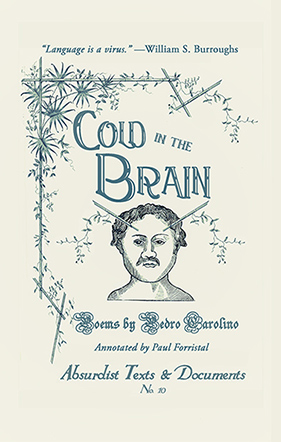
Cold in the Brain
Poems by Pedro Carolino
With annotations by Paul Forristal
Absurdist Texts & Documents No. 10

$10.00
5¼” x 8¼”, Perfect-Bound. Illustrated. 32 pp.
Limited to 69 copies.
Poetry / Unintentional Humor

SOLD OUT

Brain Drain

forcoldblog

This lovely 18th century woodcut is but one of several illustrations included in Pedro Carolino‘s collection of poems, Cold in the Brain—just published in our Absurdist Texts & Documents series.

At first glance one might suspect that the image has been tampered with—(the subject appears to be wearing a headset)—but this is not the case. The illustration is simply that of a young, drooling poet in the throes of inspiration—wearing earmuffs to undoubtedly muffle distracting sounds while he  listens to the voice of his muse.

Had the artist intended to create a headset, then we’d be admiring the work of a visionary artist far ahead of his time. Parenthetically, had Carolino been a poet “ahead of his time” (as opposed to a head of his time, which he probably was) we’d have chosen illustrations from the 20th century.

cold-cover

Pedro Carolino was a 19th century Portuguese poet and translator, best remembered (if at all) for his Portuguese-English phrase book, English as She Is Spoke (often falsely attributed to José da Fonseca). The book is a classic of unintentional humour since its author could not speak English. According to Wikipedia Carolino used a French-English dictionary “to translate an earlier Portuguese-French phrase book, O Novo guia da conversação em francês e português, written by José da Fonseca.” Without permission, Carolino added Fonseca’s name to the book in an attempt to cash in on that author’s successful work. As for Carolino’s poetry, it would never have seen publication but for an earthquake in Lisbon, during which a casket containing the manuscript was unearthed.

Paul Forristal is the former Jean Poquelin Distinguished Visiting Professor
of Carolino Studies at San Diego State University. He is the author of Ronan, the definitive biography of the Brazilian-born Equatoguinean football defender Ronan Carolino Falcão, which has been translated into four languages, including Portuguese, Spanish, and Equatoguinean Spanish. Paul is currently at work on a guidebook for Carolino Canyon, a 40-acre day-use facility nestled in the juniper-pinion forests near Albuquerque. He lives in the Illinois Valley of southern Oregon.

Black Scat’s deluxe, annotated edition of COLD IN THE BRAIN is limited
to 69 copies.

CLICK HERE TO PURCHASE

Laughter & Cheer for the New Year!

A Cami Sampler

We proudly present a New Year’s treat—#9 in our Absurdist Texts & Documents series: A CAMI SAMPLER, translated from the French by John Crombie in Paris. The collection includes 10 zany, Dadaesque microdramas by Pierre Henri Cami, plus nine pages of his rare drawings. This is the first collection of Cami’s mini plays to be published in the U.S.

From the introduction by John Crombie:

“Though blissfully ignored for most of his life by the
English-speaking public, Cami (Pierre Henri) remained
for four full decades one of France’s most prolific,
and acclaimed, comic authors. Hailed by his idol and
admirer Charlie Chaplin as ‘the greatest humorist in the
world,’ Cami was somewhat willfully omitted by André
Breton from his Anthologie de l’Humour Noir—no doubt
on account of his huge popular success—but admired
by other Surrealists. Between 1910, when he founded
Le Petit Corbillard Illustré, the ‘humorous organ of the
corporation of undertakers,’ and his death in 1958,
Cami published well over forty volumes of minidramas
and comic novels—notably The Memoirs of God-the-
Father, The Adventures of Loufock-Holmes, The Son of
the Three Musketeers, and the travels of his perhaps most
famous creation, Monsieur Rikiki and the Rikiki family—
as well as countless songs, strip cartoons, screenplays
and even operettas. Many of these he also illustrated.

But Cami was best known for his ‘dramatic fantasies,’
written mostly for La Vie Drôle, the humorous column
published weekly by Le Journal, where he had stepped,
somewhat belatedly, into the shoes of that column’s
immortal co-founder, Alphonse Allais. Self-styled
microdramas of everyday life, of legend, of history
(and even of geography), of true (and false) romance,
and more often than not of volupté, these screwball
skits look backward to the music hall and Alfred Jarry,
sideways to the Marx Brothers and forward to, in
England, the Goons and, in France, to the Theatre
of the Absurd.”

Edition limited to 100 copies.

THIS BOOK IS OUT OF PRINT

Word-Freaks of the World, Unite!

Lexicon

A new year, a new imprint: Black Scat Scholastic Classics (“A Wealth of Knowledge at Your Fingertips”), our premiere educational reference series.

We’re pleased to announce the first volume in the series—The Complete Unabridged Lexicon by Opal Louis Nations. Excerpts from this seminal (albeit eccentric) dictionary have appeared over the years in obscure little magazines and avant-garde broadsides, but now Black Scat Books unleashes the entire unexpurgated edition in a deluxe 128-page trade paperback.  OUT OF PRINT

lexicon-cover

As for the OED…it’s time to toss that dusty dinosaur in the dumpster and make room for this contemporary masterpiece which, according to The Brighton Daily Herald “…gives new meaning to the word definition.”

ABOUT THE AUTHOR:

Opal Louis Nationsphoto by Ellen Nations

Opal Louis Nations was born in Brighton, England. During the mid-1960s he worked as lead vocalist in London clubs with the late Alexis Korner’s Band, and later his own group, The Frays. He helped popularize American soul-based R&B and gospel music in Great Britain. After brief periods with various London R&B bands, he turned his back on singing and began a career as an experimental fiction writer. His textual work, sometimes strange, sometimes humorous in nature, appeared in over 200 small press magazines around the world. He is the author of over 30 books of fiction, including The Strange Case of Inspector Loophole (Véhicule Press), Stabbed to Death with Artificial Respiration (Coach House Press), and Etiquette for Ladies and Gentlemen of Good Society (Obscure Publications), as well as drawings and collage. As an editor, he brought to the public’s attention fresh young poets and writers, both in the publication of books and through his literary magazine periodical, Strange Faeces. Nations currently spends his time interviewing gospel performers, writing articles on a regular basis for Blues & Rhythm, Soul Bag, and Dr. Jazz magazines (to name a few), conducting music research and compiling CD reissues for English and U.S. record companies.