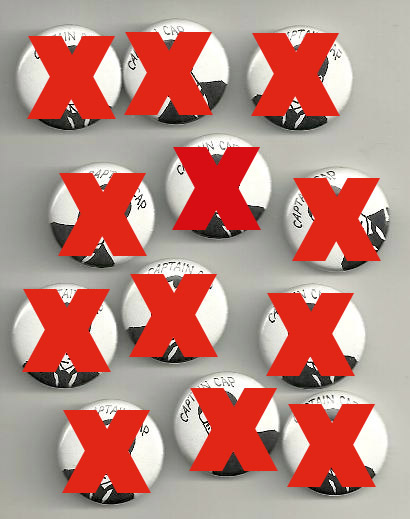
UPDATED (2/15 —9:22 am PST): All 12 Captain Cap campaign buttons are gone— but you can still order a copy of Captain Cap (Vol. I.) by Alphonse Allais – as well you should.
UPDATED (2/15 —9:22 am PST): All 12 Captain Cap campaign buttons are gone— but you can still order a copy of Captain Cap (Vol. I.) by Alphonse Allais – as well you should.

Frédéric Acquaviva writes from Berlin to inform us of the above exhibition in the UK on March 4th. Anyone planning to be in London should make a point of attending. Visitors can eyeball & sniff rare specimens of DADA, LETTRISM, FLUXUS, FUTURISM, SOUND & CONCRETE POETRY. You’ll also spot Black Scat’s Considerations on the Death and Burial of Tristan Tzara by Isidore Isou which—like a talisman–will hang suspended from the ceiling in a plastic envelope. For those unable to attend, we’ll be posting photos from the show.
* * *
We’ll also be posting photos of Alain Arias-Misson when he travels to New York City from his home in Paris. There will be many gala events from March 12-19th: an art exhibition, performance of his Public Poem, as well as a series of readings from his new fiction collection, The Man Who Walked On Air & Other Tales of Innocence – published by Black Scat. The book is now available on Amazon in Europe as well as here in the USA.
We will post details of Alain’s whirlwind tour in the near future.
While you’re waiting…
If those words send a chill down your spine, check out Tom Whalen‘s text on The Brooklyn Rail here.
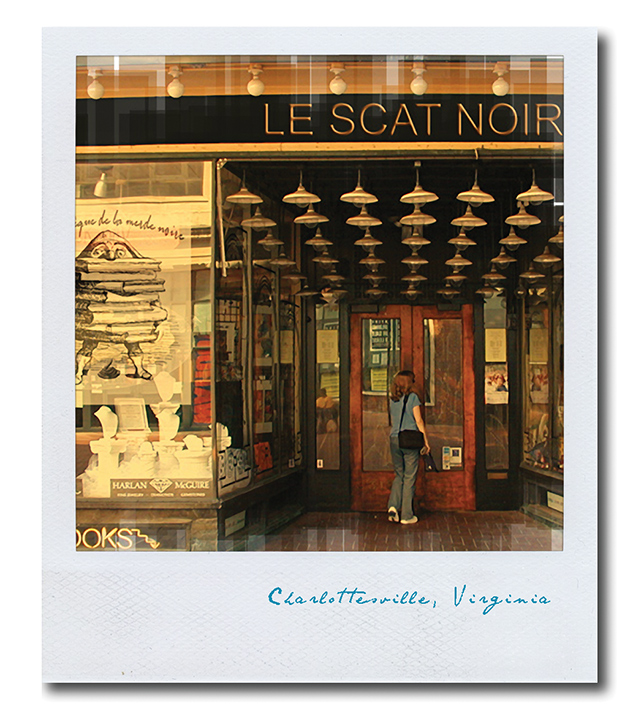
Although currently based in the SF Bay Area this press has its gnarly roots in Charlottesville, VA. There on the downtown mall (just a hop, skip & a jump from UVA) stood one of the world’s great avant-garde bookstores, Le Scat Noir. Although it carried unusual art books and literature from around the world, it was best known for a huge poster which appeared in its window from time to time, resulting in the store’s temporary closure by local authorities. According to the proprietor, Norman Conquest, “It was a scat and mouse game that went on for years, much to my amusement.”
The game, however, finally came to an end in 2009 when the literary landmark went bankrupt. With a nostalgic twinkle in his eye, Conquest reports that friends assure him that whenever they walk past the vacant building “they still get a whiff of the old store.””
Fortunately for Charlottesville, a few blocks away remains Read it Again, Sam, run by Dave Taylor, another independent bookseller with exceptionally fine taste.
ALTERNATIVE HISTORY:
The original structure, erected on Market Street in Charlottesville, Virginia in 1932, was a quaint combination slaughterhouse and ice cream parlor, with a distinctive archway lit by forty-two hanging lamps. Although business was slow during daylight hours, the building swelled to life after dark, due in large measure to a brothel located in the cellar. The illegal business flourished until 1940, when it was closed down by local authorities. The building stood vacant for twenty-five years until, in 1965, it was subdivided by the flamboyant French developer Bennie Péret-O’Lay, and became a bustling beauty salon known as The House of Wax, and a hippie head-shop.These businesses gave way in the early 1970s to Break Wind Books, specializing in Civil War memorabilia, books on local history, and Southern Fried “Chick-Lit.”Finally, in 1989, the Paris-based publishing conglomerate, LSN International, purchased the property for 6.2 million dollars, and proudly evicted the former tenant. Then, on the first day in April of that year, Le Scat Noir Bookshop & Café threw open its doors to a city starved for literary nightlife. The address also served as home to this journal, with its editorial offices located below street level in the quarters of the former brothel. Here, an underpaid staff of a dozen employees worked at dimly-lit desks, producing the infamous weekly newspaper, Le Scat Noir, while music from the café above shook the walls.The bookstore quickly became known around Charlottesville as the place to go for experimental literature, pataphysics [SIC], and rare books on avant-garde art. Smoking on the premises was not only permitted but encouraged, as patrons were greeted at the door by an attractive young lady in a tank-top dispensing free cigarettes and souvenir ashtrays with the painted slogan “Where Art & Literature Hit the Fan.”
CONTINUED HERE

[TRUMPETS BLARING; BANNERS WAVING; BABIES SHRIEKING; READERS CHEERING; etc.]
Black Scat proudly announces the publication of Captain Cap by Alphonse Allais—the first of three volumes in a series of “captails” translated from the French by grand maestro Doug Skinner—who also illustrated the edition and produced its sublime cover.
Vol. I (“Captain Cap Before the Electorate”) covers the captain’s notorious political career—including an unexpurgated appendix of his favorite cocktails**.
That this work by Allais has never before appeared in English makes this a literary event worthy of balloons, noise-makers, champagne, and an inebriated marching band.

And to celebrate the Captain’s launch we’re christening this limited edition by offering a FREE Captain Cap campaign button to the first twelve connoisseurs who order a copy.
UPDATE (2/15): All the buttons are gone, alas.
Now if you’ve read this far and are wondering who Captain Cap was, here’s a brief excerpt from the translator’s introduction:
We would be remiss did we not mention that the first title in our Absurdist Texts & Documents series was Masks by Alphonse Allais, for its author embodies the spirit which inspires this small press.
Captain Cap is limited to 125 copies, so we suggest you order quickly before it’s too late.
CLICK HERE AND CAST YOUR VOTE FOR CAPTAIN CAP
And have a drink on him!
___________________
**Be sure and try the recipe for Corpse Reviver (pg. 53)

…What’s that sound?…
The sound of Oulipo Pornobongo 2 stirring in the darkness?
Lunging, thumping, humping…
Yes, sequels are never subtle.
We will be publishing this sequel to the original Anthology of Erotic Wordplay later this year, and are currently searching for appropriate texts spiced with hot oulipian constraints.
Stay tuned.
If you’d like to view last year’s lovely pornobongo trailer, click here.
****
A Note of Interest to Pornobongoids:

Tomorrow, New Directions will officially release the 65th anniversary
edition of Raymond Queneau‘s inspirational classic Exercises in Style, translated by the late-great Barbara Wright. This edition includes previously unpublished exercises as well as episodes composed in the author’s honor by Frederic Tuten, Lynne Tillman, Harry Mathews, and others.
A splendid treat, despite a typo on the copyright page that credits Stefan Themerson‘s memorable cover image to “Stephen.”
CLICK HERE to order

ADVANCE RAVES (BY ANTICIPATION) for COLD IN THE BRAIN:
“Nobody can add to the absurdity… nobody can imitate it successfully, nobody can hope to produce its fellow; it is perfect.”
—Mark Twain
“Not since Nabokov’s Pale Fire has there been…well, this.” —R. Queneau
“Gives bad poetry a bad name.”—Derek Pell
Cold in the Brain
Poems by Pedro Carolino
With annotations by Paul Forristal
Absurdist Texts & Documents No. 10
$10.00
5¼” x 8¼”, Perfect-Bound. Illustrated. 32 pp.
Limited to 69 copies.
Poetry / Unintentional Humor
SOLD OUT

This lovely 18th century woodcut is but one of several illustrations included in Pedro Carolino‘s collection of poems, Cold in the Brain—just published in our Absurdist Texts & Documents series.
At first glance one might suspect that the image has been tampered with—(the subject appears to be wearing a headset)—but this is not the case. The illustration is simply that of a young, drooling poet in the throes of inspiration—wearing earmuffs to undoubtedly muffle distracting sounds while he listens to the voice of his muse.
Had the artist intended to create a headset, then we’d be admiring the work of a visionary artist far ahead of his time. Parenthetically, had Carolino been a poet “ahead of his time” (as opposed to a head of his time, which he probably was) we’d have chosen illustrations from the 20th century.

Pedro Carolino was a 19th century Portuguese poet and translator, best remembered (if at all) for his Portuguese-English phrase book, English as She Is Spoke (often falsely attributed to José da Fonseca). The book is a classic of unintentional humour since its author could not speak English. According to Wikipedia Carolino used a French-English dictionary “to translate an earlier Portuguese-French phrase book, O Novo guia da conversação em francês e português, written by José da Fonseca.” Without permission, Carolino added Fonseca’s name to the book in an attempt to cash in on that author’s successful work. As for Carolino’s poetry, it would never have seen publication but for an earthquake in Lisbon, during which a casket containing the manuscript was unearthed.
Paul Forristal is the former Jean Poquelin Distinguished Visiting Professor
of Carolino Studies at San Diego State University. He is the author of Ronan, the definitive biography of the Brazilian-born Equatoguinean football defender Ronan Carolino Falcão, which has been translated into four languages, including Portuguese, Spanish, and Equatoguinean Spanish. Paul is currently at work on a guidebook for Carolino Canyon, a 40-acre day-use facility nestled in the juniper-pinion forests near Albuquerque. He lives in the Illinois Valley of southern Oregon.
Black Scat’s deluxe, annotated edition of COLD IN THE BRAIN is limited
to 69 copies.
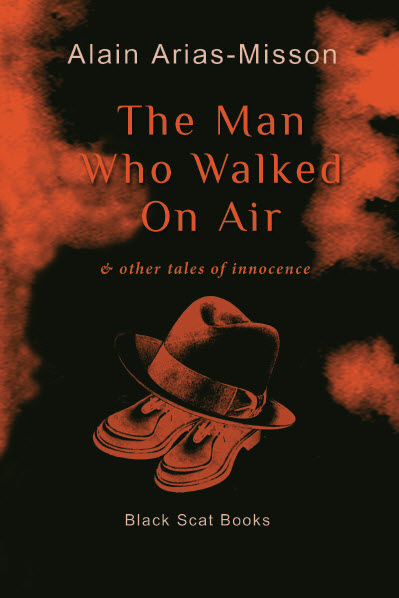
JUST PUBLISHED: A major new collection of short fiction by Alain Arias-Misson—a master of literary mischief. These fifteen “tales of innocence” are erotic, poetic, mysterious, funny, and always surprising.
ADVANCE PRAISE FOR THE MAN WHO WALKED ON AIR & OTHER TALES OF INNOCENCE
“The title story of Arias-Misson’s The Man Who Walked on Air is emblematic of the fiction collection. Ruminative, cultivated, formally venturesome, smoothly (but not slickly) written, and erotic—a nuanced eroticism that takes deliciously improbable turns. A daring collection in its way, yet always engaging.”
–Harold Jaffe
“Augustus, Alain Arias-Misson’s alter ego in the book, levitates when he has an erection. Arias-Misson levitates when he writes. Take the hand he offers you. He will lead you above the coarseness and banality of much of contemporary writing to a delightfully innocent world of erotic fantasies.”
–Yuriy Tarnawsky, author of Short Tails
 The legendary literary maestro, Alain Arias-Misson, has disappeared from Paris. Well, no, that’s not quite accurate… he hasn’t vanished in the sense that, say, a CIA operative might suddenly leave the scene. No…Alain is basking in the balmy breezes in Panama. He and the lovely Karen avoid the nasty winters in France by disappearing (escaping) to their undisclosed hideout (is there any other kind?) on the Pacific. Actually, their hideout looks like a love-nest, oui?
At the Black Scat Books bunker in northern California, we’re all rather jealous of M. Arias-Misson since temperatures have dipped to 30-degrees! In other words we’re freezing our butts off but cannot afford to escape.
To make matters worse, Arias-Misson sends taunting emails from Panama wishing us warm regards, etc. We took revenge, however, and made certain his vacation was interrupted by a lot of work, i.e., we gave him stiff deadlines for compiling his collection of short stories: The Man Who Walked on Air & Other Tales of Innocence.
This, by the way, is a significant edition featuring 15 “innocent” tales, spanning 195 pages — experimental, erotic, poetic, passionate, obsessive, and hilarious. But that’s stating the obvious… damn it, the man is bloody brilliant and we’re honored to be unleashing the book any moment now. (No joke, check back here today.)
Why a winter pub date you ask?
Once the new book rears its head on Amazon in the U.S. and Europe, the author will head to New York where he’s always in demand for readings and performances.
And NYC is cold as hell in winter.
🙂
 blackscatbooks.com